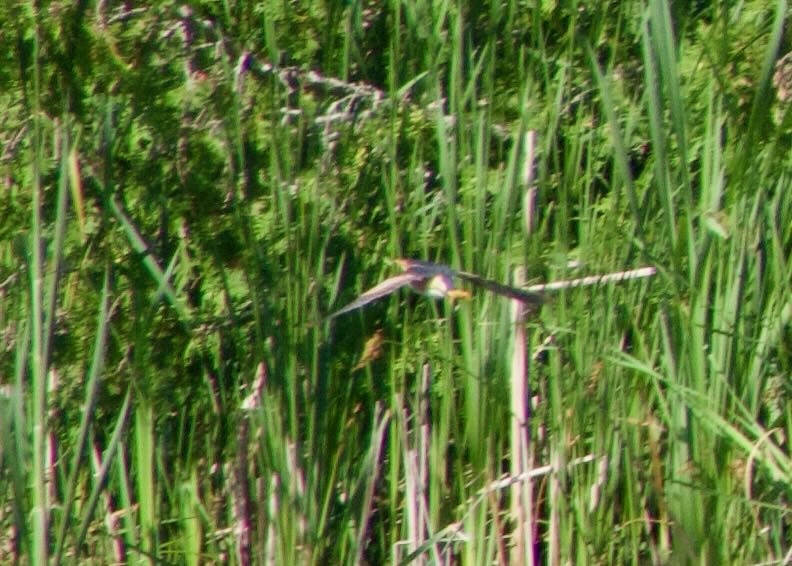
Canada Day we were at Confederation Park in Hamilton to cheer on our our daughter’s family as they ran 1&5K races to raise funds for McMaster Children’s Hospital. We did a bit of a Lake Watch at Van Wagners afterwards to just practise our skills at identifying birds at a distance with the scope. Starting in August we are going to have to spend quite a bit of time at this spot hoping to get Jaegers and rarities coming in. The rest of the week we looked after grandkids and then on Friday headed up north for a weekend with our kids and grandkids at Viamede Resort. We left early Friday and stopped along the way with the goal of seeing and getting a pic of a Least Bittern. We did not see a Bittern at our first stop at the Darlington Waterfront Trail but further north we stopped at Duoro Park in Peterborough. We saw nothing in the actual park but decided to check the river from the road bridge beside the park. Jerry was taking some pictures of a Green Heron when suddenly a Least Bittern flew almost eye level over the bridge. It was only seconds before we got across the road but the bird had disappeared on the other side. I had a fantastic view of it and Jerry missed it. We scouted the area and then decided to go back into the park for a different view of the area we were sure it must have landed in. We scoped for a bit and then it flew up out of the reeds we had been scanning and went down river back to the other side. Jerry managed a crappy shot but we achieved our goal and saw a Least Bittern and got a picture.
We put in a few lists over the weekend with Loons and Warblers all the while really hoping an American Goshawk would fly over the resort but we were just not that lucky haha! We birded in a few more Counties so our new goal of birding every ebird County and District this year now stands at 41 with only 9 more to be birded.
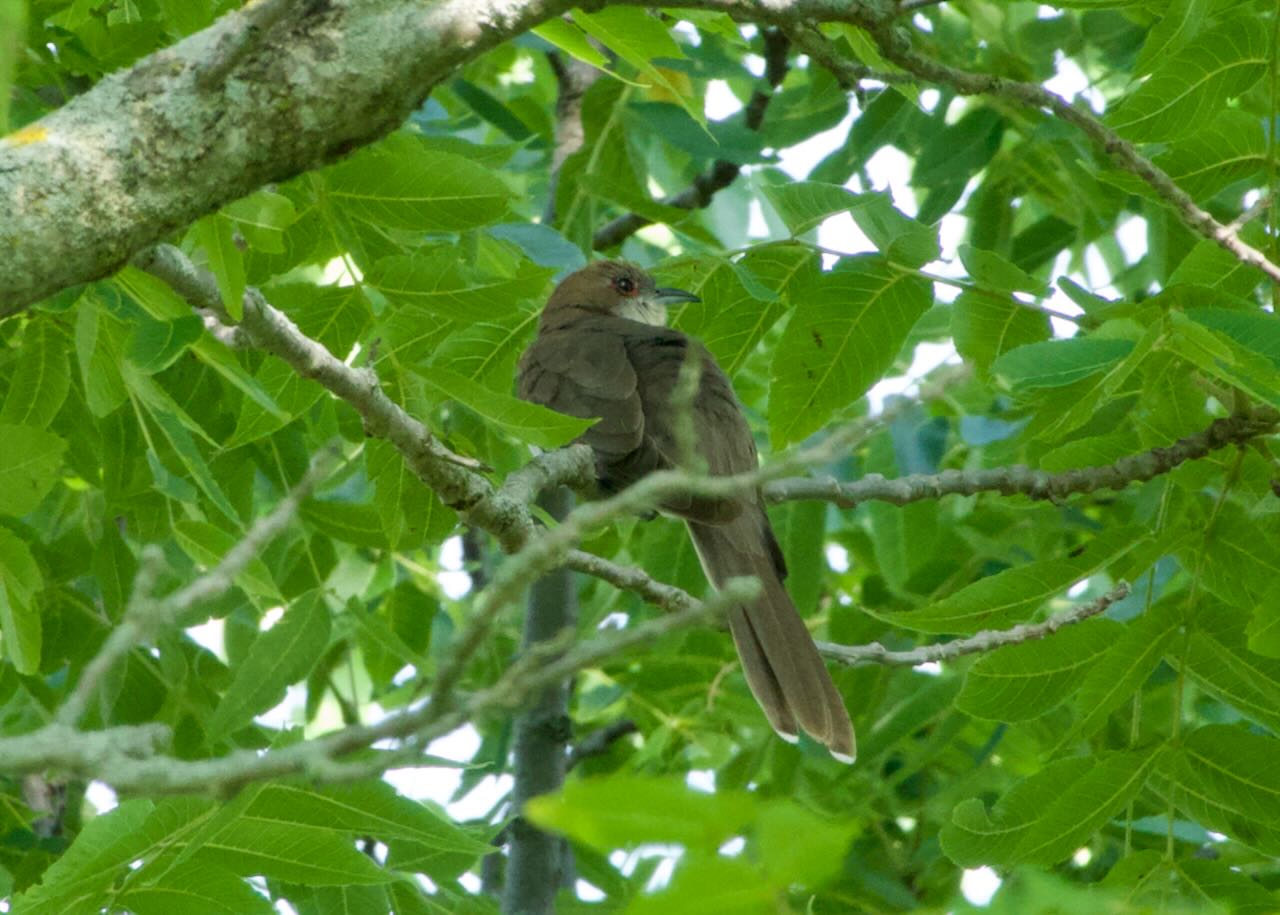
On Monday we birded locally checking some of the storm ponds. Shorebirds are the first migrants to start back and a few are starting to be reported. While we were at the Paris Stormwater Pond Jerry saw a Cuckoo flying from the field to the trees along the road. We have only heard a Black-billed Cuckoo so we hoped this bird was it. We headed out to the road and paced back and forth keeping our eyes on the trees and then heard that distinctive song of cu-cu-cu-cu-cu meaning it was a Black-billed! We waited, we watched, we looked and at long last I saw it hop onto a branch. Jerry ran over and it flew a few trees away, he managed a picture and then it flew to another tree and then flew out towards the field. We scrambled through the scrub and trees and got back out into the field and waited again. In a few minutes I saw it fly between trees and we finally had a clear look at it and Jerry was able to get some good pictures showing its black bill. Another “Heard Only”bird changed to “seen and photos taken bird.”
We now have 8 “Heard Only” Birds left on our list and I hope we can still remove a a few more in the coming months but I know that we will not remove them all.
Week 28
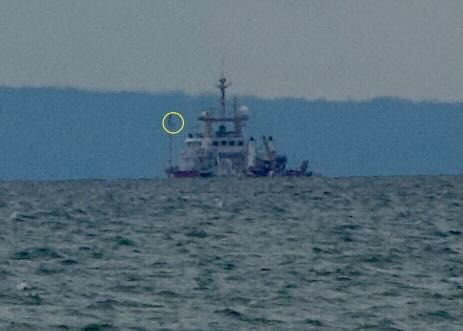
Late Monday, Marcus in Hamilton saw a mega rarity out on Lake Ontario just before dusk. A Common Murre is a first Ontario record! His sighting was not long, just a few minutes, and although the bird was a long way out they are pretty distinctive birds from the East and West Coasts. We decided to do some lake watching on Tuesday in the hopes of seeing this bird and started at the spot Marcus had seen it. We then worked our way towards Toronto stopping to view and scope the lake. We did not find the Murre and planned to head out again on Wednesday or Thursday to work our way from Hamilton to Niagara. Late Tuesday, (why are the great reports always minutes before dark?) a report by a crew member on a Coast Guard boat in Lake Erie was put on INaturalist that a Brown Booby, another mega rarity, was sitting on their boat offshore. With Hurricane Beryl making its way up from the US on Wednesday there was an expectation that some rarities would arrive here before, during and after the storms. So far there had been a Roseate Tern, the Murre, and the Brown Booby. None that were easily chased. But Wednesday around 11 the rain lessened and we headed down to Long Point to canvass the shoreline for the Booby or a Stilt Sandpiper that had been reported a few days before. We met two birders, Jax and Jack at Hastings Drive and birded there for a bit moving on to check out Turkey Point and Port Dover. Before we left Long Point I handed my business card to the guys. At 5:19 my phone lit up with a report from the guys who were still at Long Point that they could see the Coast Guard boat and what looked like a Brown Booby on it. We jumped in the car and headed back, 30 minutes away. The guys texted (thanks for that help!) and we had a quick discussion regarding the boat direction and made the decision to get down to the beach at Long Point east of where they were. By this time the original reporter of the bird had confirmed that the Brown Booby was back on the boat so we knew all we had to do was see “a bird” on the boat for it to count. We flew out of the car and I could see the boat, grabbed the scope and got the scope on the boat. The view was horrible but we could see a shape that looked like a bird on the front mast! Number 310. Whew. We only spent about 5 minutes there and decided to drive further east into the provincial park for maybe a better view. The boat was further out but more sideways in the water so the shape of the bird was marginally easier to see. This will undoubtedly be the worst view and the worst picture of a bird this year. I am glad that it was not a lifer for us. The last Booby hung around in Hamilton for a number of weeks so there is hope that the bird will eventually roost where it might be more easily seen. The reality though is, it will not survive up here on a fresh water lake, it belongs in the warm southern oceans and will die sooner rather than later.
On Friday we headed to Alymer Wildlife Management Area because there had been reports of Stilt Sandpipers the last couple of days. When we arrived a birder told us that he had seen one but the lighting was horrible. The viewing is limited to permanent wooden stands and so we were facing east to see where the birds were with the sun in our eyes. In those conditions the birds are all black silhouettes but when they move you can pick up some detail. After scanning for a bit I was sure I had the Stilt – I could make out a bird with a heavy eyebrow that was dark on top and underneath. Jerry had a scope look and then tried to get pictures. We felt confident we had the bird and put in a checklist and decided to continue birding and come back in the late afternoon when the sun would be behind us. We checked out other lagoons and wetlands down near Rondeau and then headed back to Alymer in the late afternoon. I had a migraine most of the day and it was getting worse as the day got hotter so I was not as focused on birding as I usually am. We met up with another birder, Dorlisa at Alymer and searched for the Stilt to no avail. I was beginning to have second thoughts that we had seen it in the morning. We went home and looked through all the pictures and all we had were many Lesser Yellowlegs that are somewhat similar to the Stilt Sandpiper. We removed it from our list.
I am always aware of the cognitive bias’s that all humans have and the ones that can affect a birder when we are deciding on an ID. Expectation Bias happens when someone tells you a bird is there and then your brain finds what you are looking for even if it is not there. I think that is what happened with the Stilt – we were told it was there and so we found a bird that had close to the characteristics we were looking for. Authority Bias can happen when an accomplished birder announces an ID and everyone else goes along rather than consider the bird themselves. Everyone makes mistakes, even the best birders, and so it is always important to try and confirm an ID yourself. Today, with most people taking pictures and posting them quickly there are less chances of these bias causing major mistakes but back in 1988 in England a major birding mistake became the hallmark story for these bias. You can read the detailed version here. https://www.birdguides.com/articles/general-birding/phantasms-and-fallacies/
The shortened version is a rare warbler was caught and banded, pictures were taken and the bird was released. The bird was supposedly “refound” and 600 people traveled to see the bird over the week and the people that had banded the bird often were the ones showing the bird to the others. Everyone went home happy. The author of the article, a teen at the time, thought the bird did not check the boxes for the rarity but didn’t question the experts. The next day the bird started to sing and it was a common warbler that looked a bit weird from the norm, not the rarity at all! Those bias’s had clouded all of the 600 people seeing that bird, even the original bander who had held the real rarity in his hand!! Crazy right?!
I read about these bias’s when we started birding and I am acutely aware but even with awareness you still find yourself falling into the trap of them. I often second guess myself after seeing a really good bird because I don’t want to make a mistake so I often talk myself out of an ID rather than be wrong. I’m glad that Jerry takes pictures for proof that I really did see it. I hope the more we bird the better we will be at avoiding these bias’s.
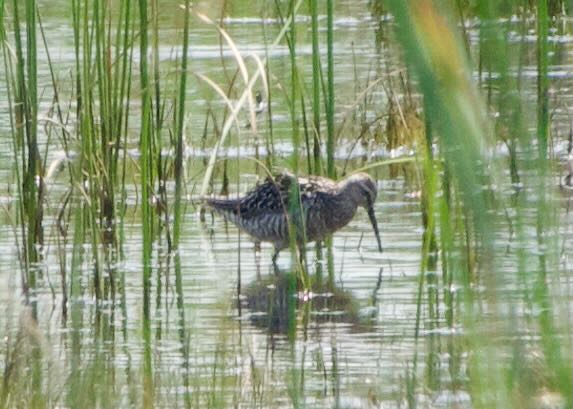
On Sunday morning we headed to Long Point where Stilts had been reported on and off for over a week. We spent a few hours on the beach off Hastings Drive but no Stilts. We then headed over to Crown Marsh, then back to Hastings and then decided to head home but first I suggested we head back for one more stop at Crown Marsh. We walked down the trail and Jerry found a Stilt in with some Lesser Yellowlegs. We had great scope views and this time there was no doubt that it was a Stilt! Heavy barring underneath, a prominent eyebrow, a thick black bill with a bit of a downturn, a bit smaller than a Yellowlegs. All the boxes checked, we had Bird #311 to end the week.
Week 28 2 new species added 311 Birds seen J&E