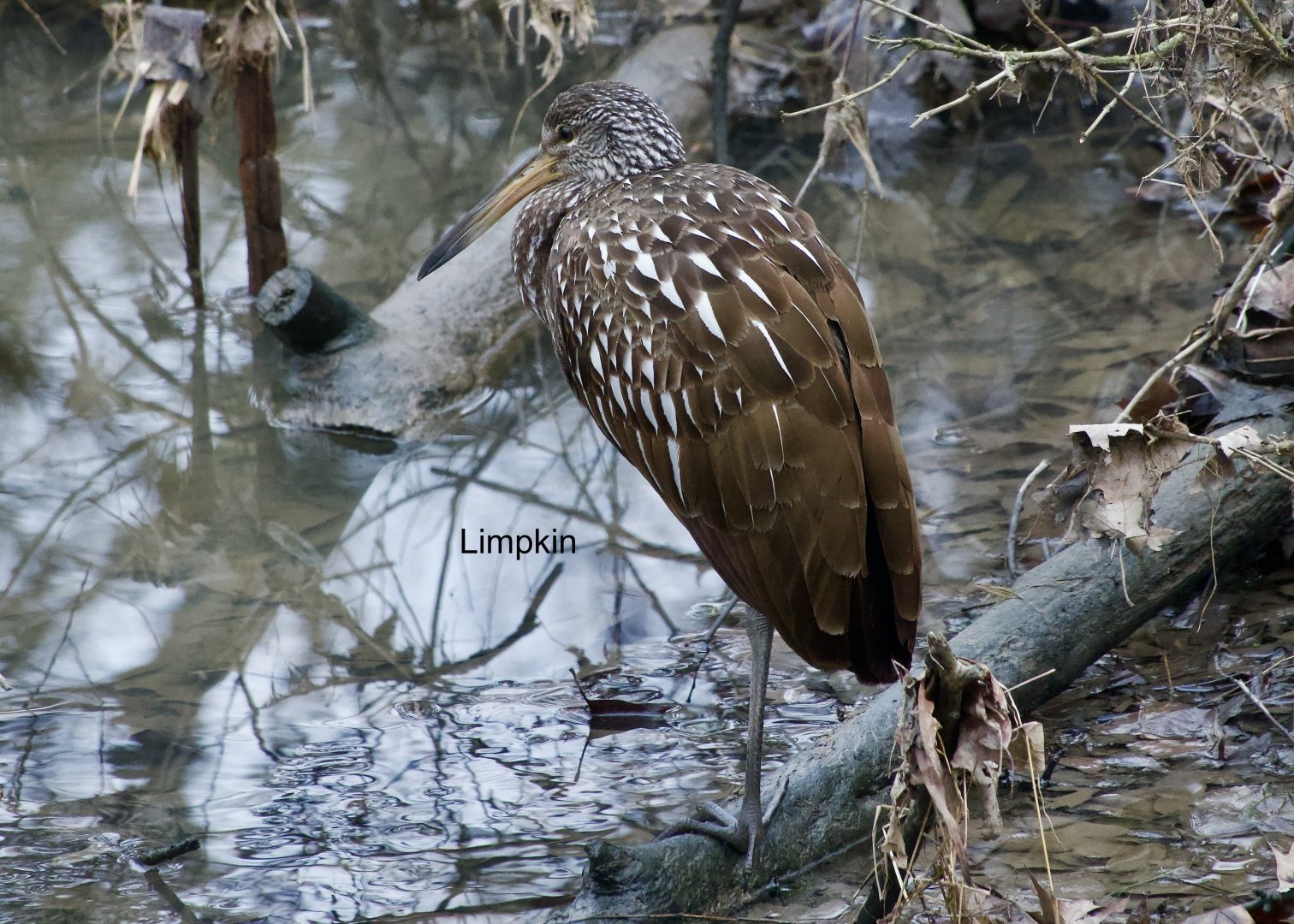
January 8, 5:00am the alarm went off and we were out of bed and the house by 5:33. The Limpkin, a species rarely seen north of Florida was re-found in Wheatley Provincial Park after not being seen since December 26. A birder used a thermal imaging scope to find it late January 7. This is one of those mega rarities that birders hope for in their Big Years. We were first to arrive and did not see the bird up the creek from the road and were not sure how far to walk in – we didn’t want to flush the bird, but within minutes birders arrived and Rick (from Pelee) quickly showed us where he had seen it the night before and THERE IT WAS!
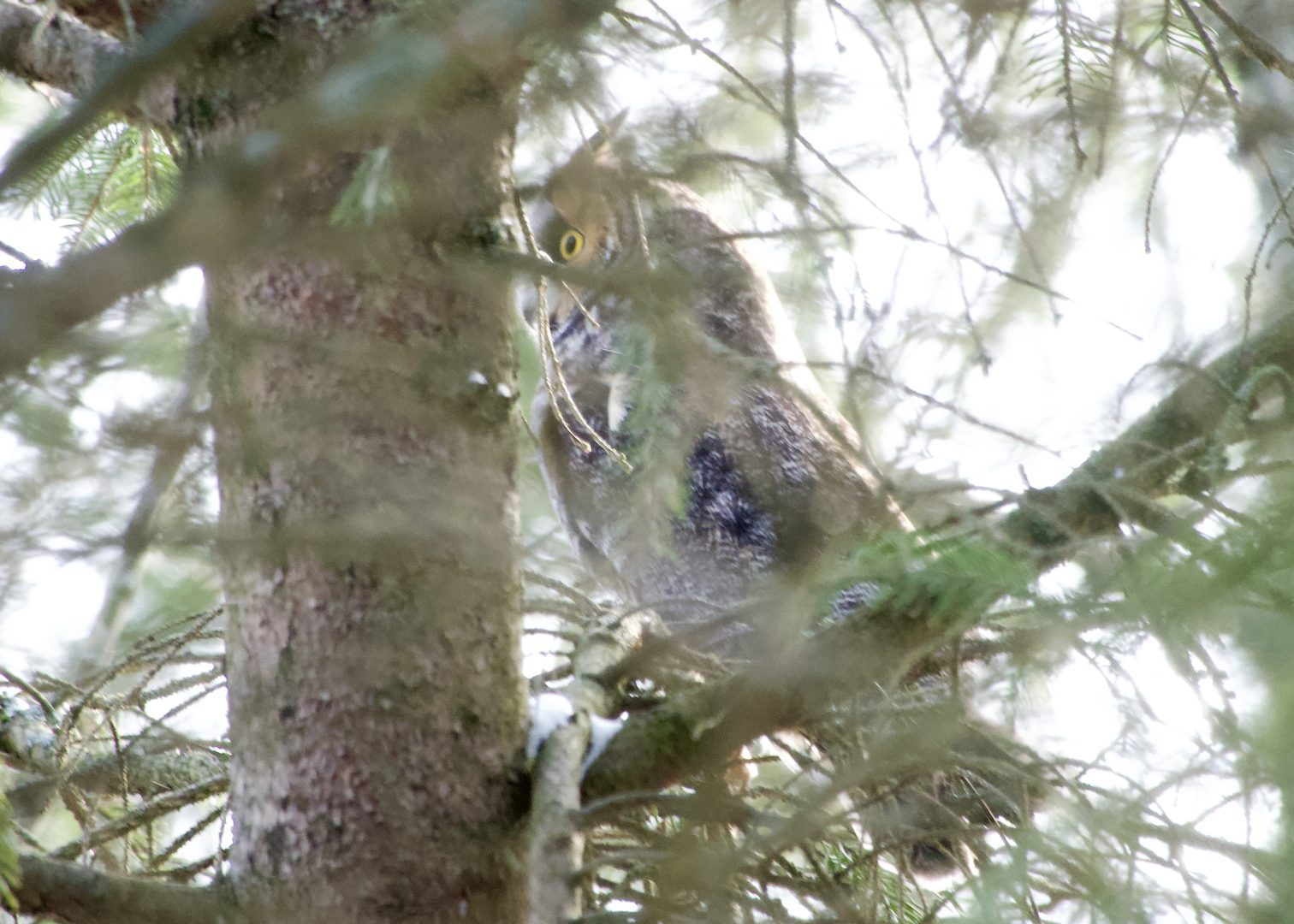
It looked in pretty good shape and after a few minutes to take some pics and video we left it, not wanting to over stress it. There were bound to be more birders arriving all day to see this mega rarity. A fantastic start to Week 2! The rest of the week slowed down with Jerry having some minor surgery and some nasty weather keeping us close to home for a few days. We managed to add 14 more species this week including our first two owls, a Short-eared Owl hunting at dusk in Haldimand and a Long-eared Owl on a private site in Brant County.
There are 10 Owl species in Ontario with 7 seen regularly in the south and 3 seen in the North. Most years we will just have Heard Only reports of some of the owls but this year we would like to get pics so we will be trying to see as many of the species as possible. Owls are much sought after by birders and photographers and there has been much discussion as to how we keep the birds safe from the few unethical people who do not consider the birds when viewing and photographing. Many owls are considered sensitive species now to protect them and the sightings just do not show up publicly for anyone to see, our Discord chat group does not allow owl postings, nor does Ontario Birds FBook group. Seeing an owl is a fantastic experience but we make sure to keep a long distance, spend as little time as possible and do not divulge locations especially of nesting owls until after the breeding season. Our focus for the next week is more owls, a few ducks we are missing and then I think the end of the week, weather permitting, we will be heading north for our first trip to Algonquin. I expect that we will only add 1-2 birds per day going forward until Algonquin. My goal is to get to 100 species by the end of February and I should hit that target with the Northern trip and the local owls and ducks.
Week 2 1 rarity, 2 owl species, 14 species added 91(E) 92(J) species seen
UPDATE! On Sunday January 14 a few people captured the Limpkin and took it to a Wildlife Rehab. There are mixed opinions, those birders that believe in “nature taking its course” and those birders that believe we should try to “save” everything. It was no doubt in stress with the extreme cold and its food source (snails) frozen over and would have likely perished in the next day or so but it likely faces a stressful rehab of trying to be force fed and end up having to be euthanized in care. No easy answers…I’ll keep you posted if I hear more.
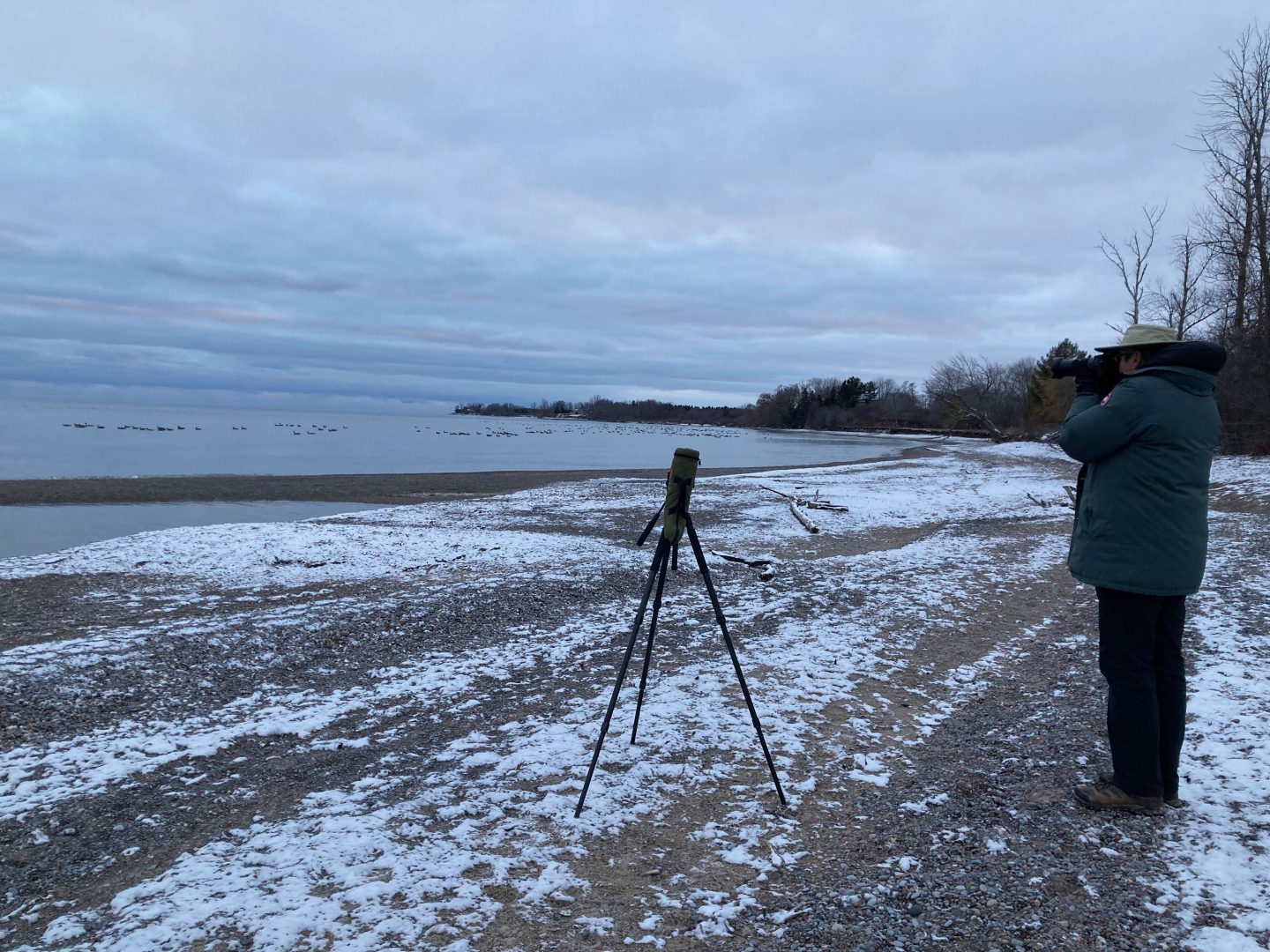
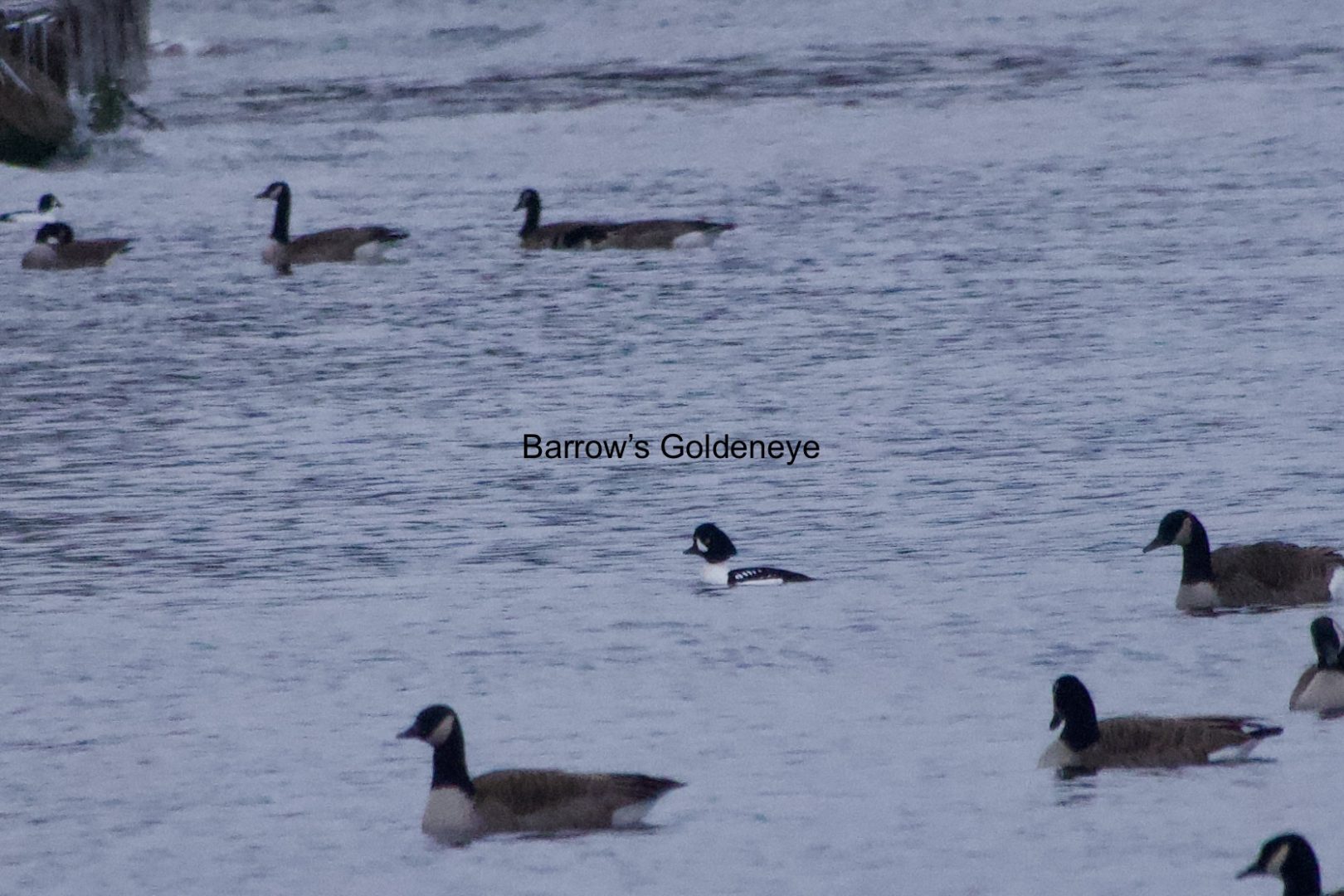
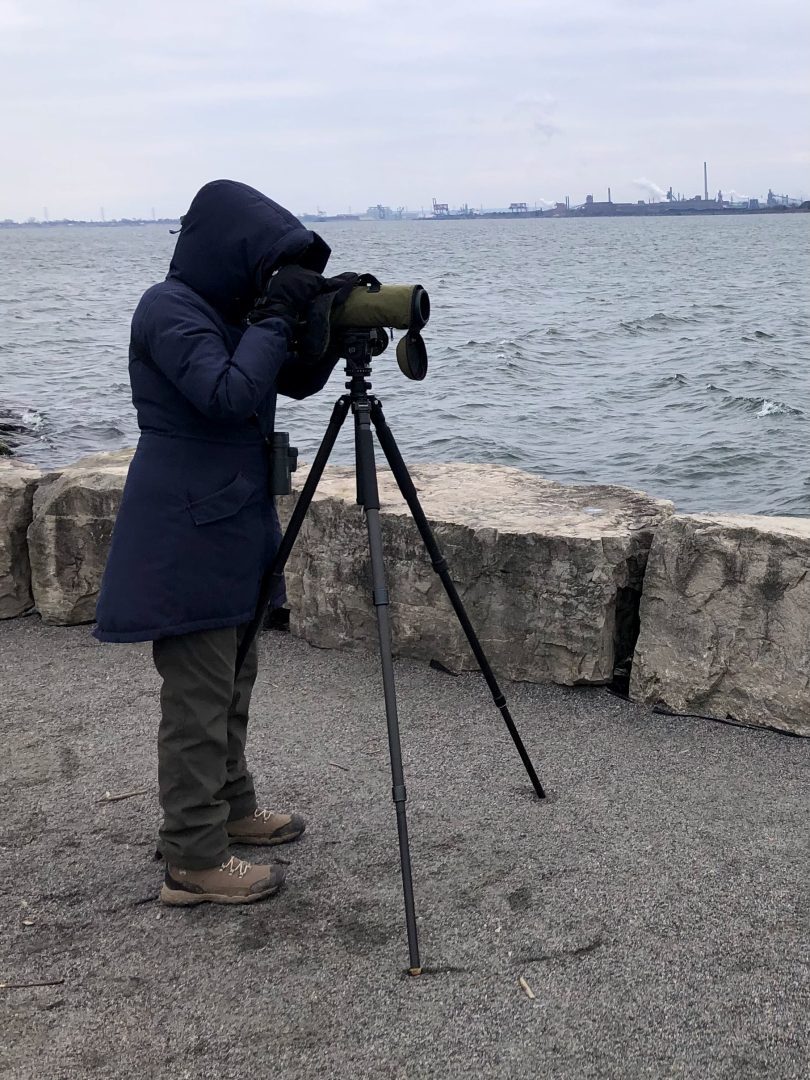
Finally! It has begun…The goal for the first week was to chase any and all rarities. For the last month I have been following rarities in the province and hoping that some of them would remain into the new year. Most rarities at this time of year end up perishing when snow and cold arrive but the milder weather has meant a few have managed to stick around. We ended up deciding to start our year in Ottawa trying for a Western Tanager that has been there since December 15. Then try for 4 other rarities on the route home. The best twitching strategy is to be at the spot at first light. We were, the bird was not. After standing in -10 cold for 2 1/2 hours we made the decision to try for the rest of the rarities. The bird showed up 40 minutes later! Lesson learned – leave more time and stick it out until the bird shows or it is dark. LOL. We also dipped (missed) our second rarity but knew of a second bird at Pelee so didn’t waste too much time but by then we only had time to stop for one more before dark. At 4:30, with light fading and a run/walk down a 2km beach on Lake Ontario I saw a Barrow’s Goldeneye in the scope. There was much frivolity! Well, a high five and a frozen smile. Did I mention it was cold?
While it was not the stellar start to the New Year, we took away some lessons and things got better on our second day as we headed to Pelee National Park for a Townsend’s Solitaire. A birder re-found the bird and a small group of us enjoyed watching it feed on the blue berries on cedar bushes. After spending some time at the Tip in gale force winds we headed to Erieau for a Harlequin Duck. The wind was even stronger and the waves were crashing along the pier but Jerry braved the elements to get as close as he could to get pics of the tiny duck diving beside the concrete pier. Did I mention it was cold?
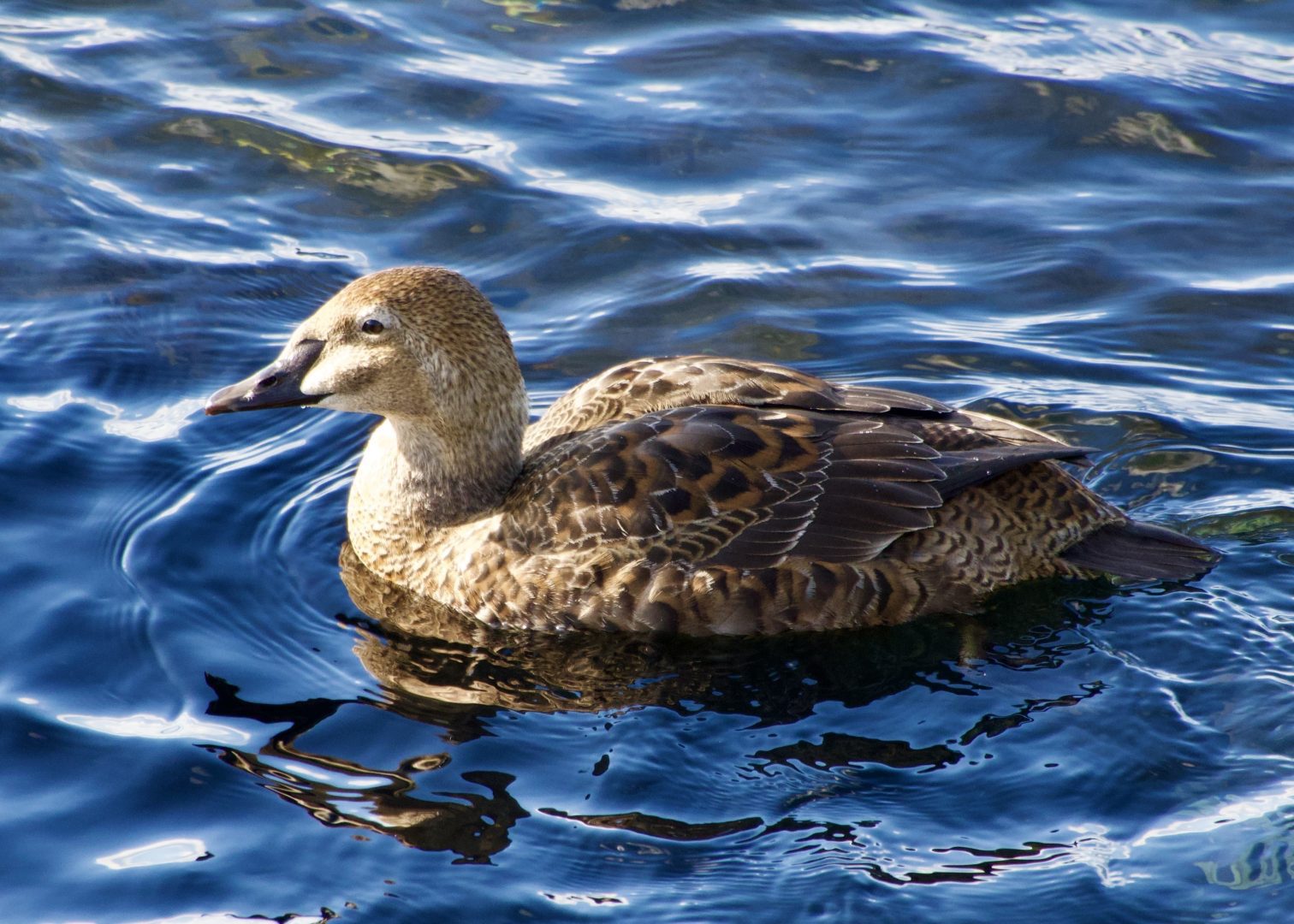
Day 2 – 2 rarities and one semi-rare and 56 species seen. We next headed to Brampton for a Ross’s Goose and then Colonel Sam Smith Park in Etobicoke for a King Eider and an Eared Grebe. Got 2 of the 3 as the Eared Grebe had not been seen for a few days. It was a female King Eider so just a brown duck but google the male and check out his colouring.
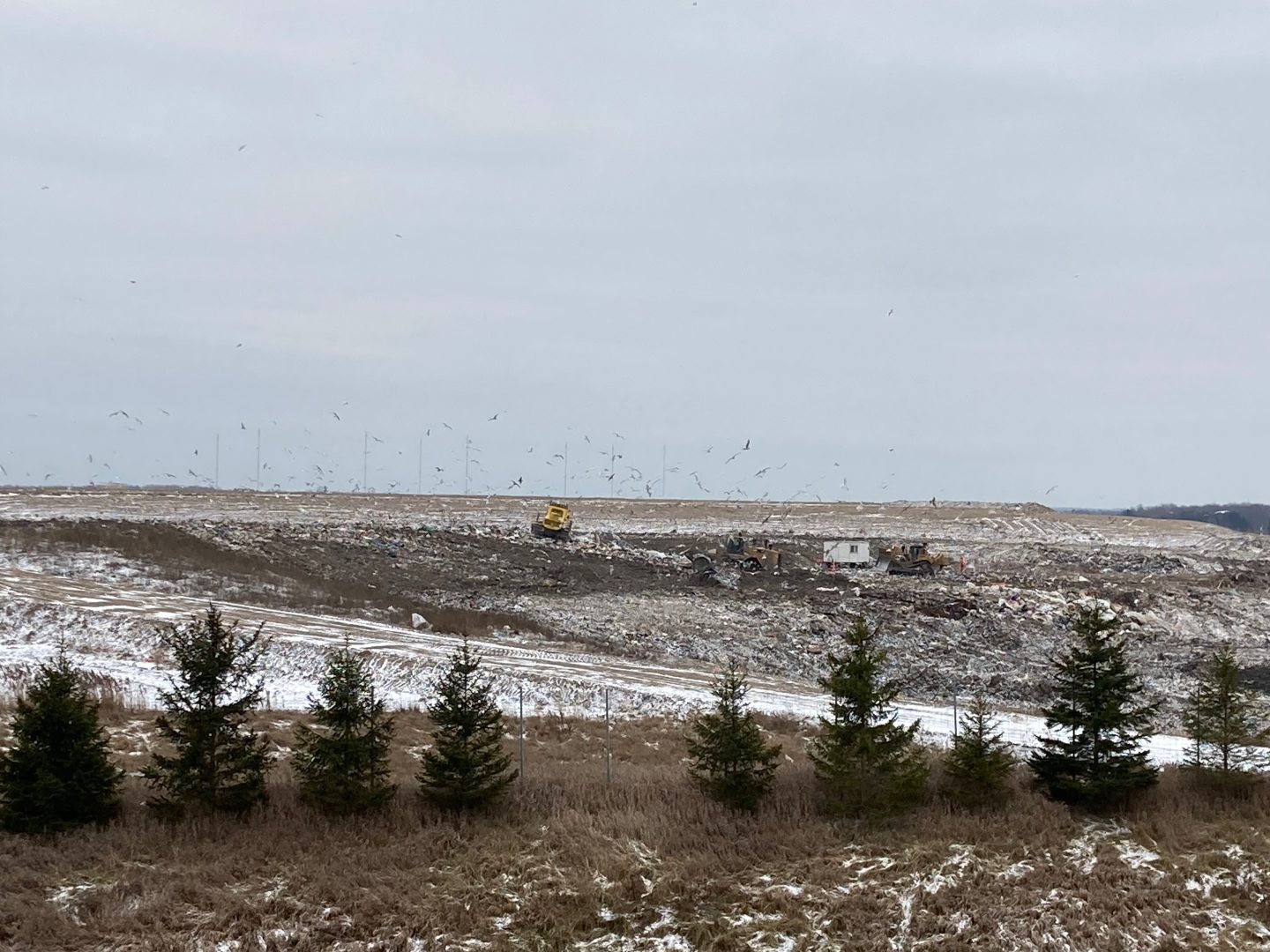
The following day found us at the London Landfill (yes, birders spend lots of time at landfills and sewage lagoons) where we played one of these things is not like the other 2,000 and really thought we had found the one Slaty-backed Gull among all those gulls. Maybe lack of sleep, covid, or just our inexperience led us to celebrate instead of grabbing the scope and really looking at the distant gull because once the reviewer looked at our pics he gave us the thumbs down. UGGGGGGG! Classic newbie mistake! We have promised each other that going forward when we think we have a rarity one of us will say the code word “Slaty” to remind ourselves to check and double-check and check again.
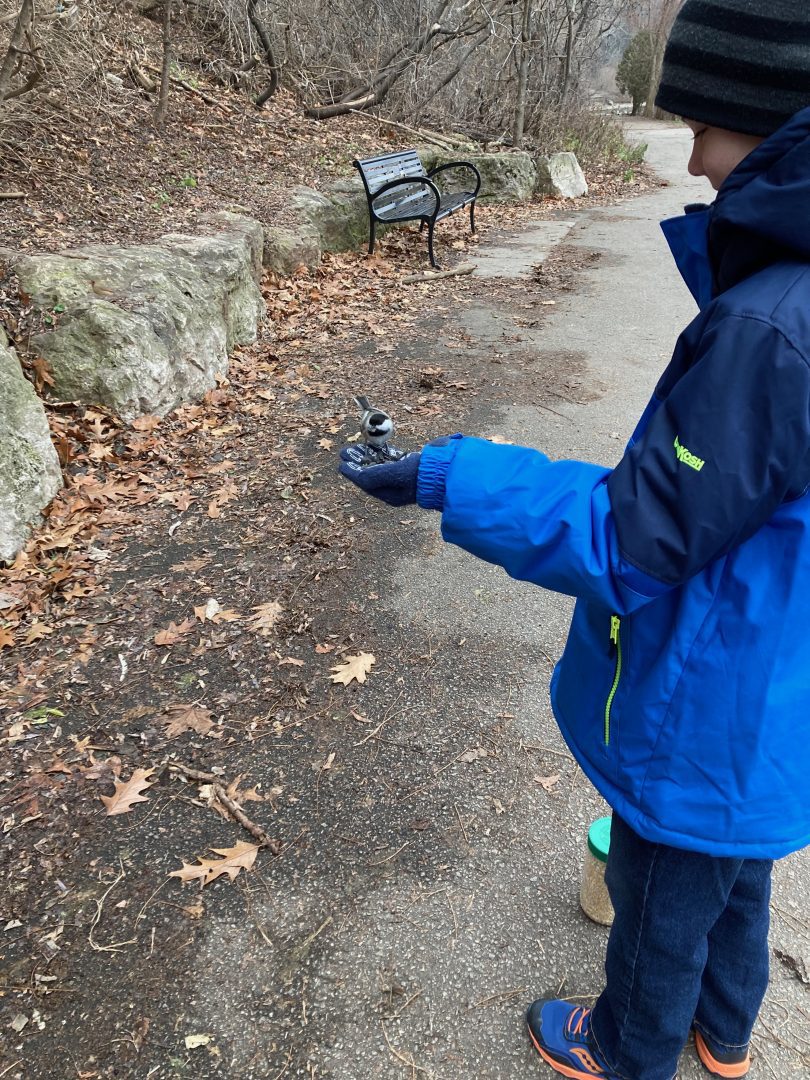
We tried for the Pacific Loon and Western Grebe in Hamilton twice more this week and did I mention it was cold? LOL. Both of us felt we saw the loon in very rough water for seconds but just not good enough looks for us to be 100% confident that is what we saw. There is also a Red-throated Loon being seen and they are similar enough at long distances to us that we want to be sure of what we have seen. We even had some time to spend a few hours with our grandkids feeding the birds at LaSalle.
Saturday we decided after 6 days of driving and birding we needed a day off. We still added 2 common species, one at our feeder and the other, a Tufted Titmouse ( a bird not a mouse) at a boardwalk nearby. The last day of the week we headed into Hamilton again, ever hopeful for calm water and IT WAS! LIKE GLASS! Within minutes we had great looks at what was definitely a Western Grebe and close enough to get pictures. We managed to see a Red-throated Loon but quite a distance out and then on the advice of another birder we headed into Hamilton to look for the Loon further along the bay. The Pacific Loon was THERE! We have tried multiple times for this bird so it was great to finally catch up with it and still had a couple of hours before Benson’s hockey game so we chased down a very out of season Orange-crowned Warbler at Princess Point. Both Jerry and I saw it at different times as it flew across the tops of the grass but did not get great views. Oh, and Jerry saw a Brown Creeper that I did not so we end the week with HIM AHEAD OF ME BY ONE BIRD!!! I’ll get a Creeper in the next day or so but SHEESH! LOL. Still, a triumphant end to a long, very cold, windy week.
Week 1 3 rarities, 8 semi-rare and a total of 77(E) 78(J) species seen.
BREAKING NEWS!!!! The Limpkin (a Florida bird) was refound at 4:00. We will be there at first light to try and re-find it!
In 2022 I ended the year with 199 species seen in Brant county, and Jerry managed to get 200. Did I mention I am competitive? and it bothered me, a teeny bit. I could easily have got the extra bird but I was lazy and let him go birding many times while I sat on the couch. He also managed to be 1 bird ahead of me in Ontario as he saw a Louisiana Waterthrush at Pelee that was gone by the time I got bins up so I vowed it would not happen again. I would commit to getting out to bird every time he did, become his shadow, and I would get 200 in the County in 2023.
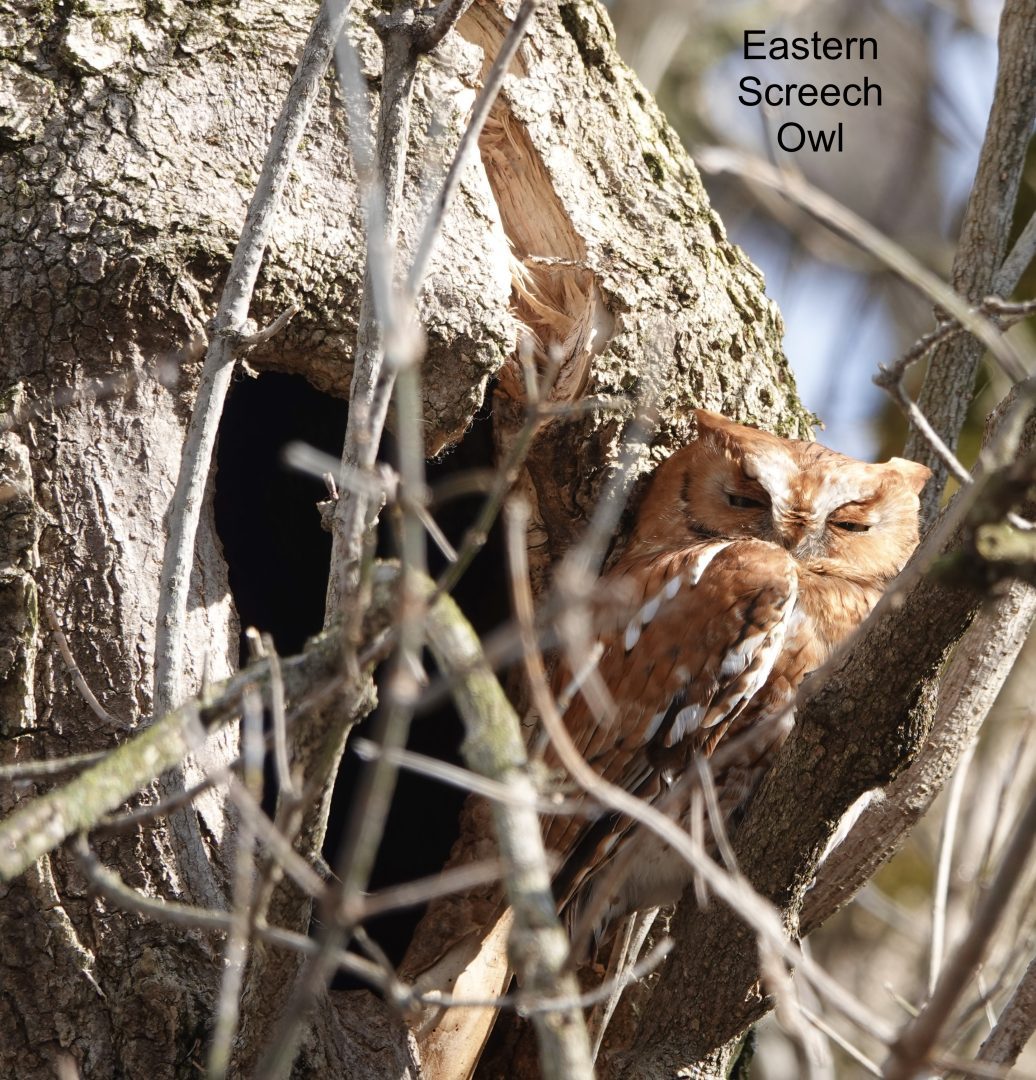
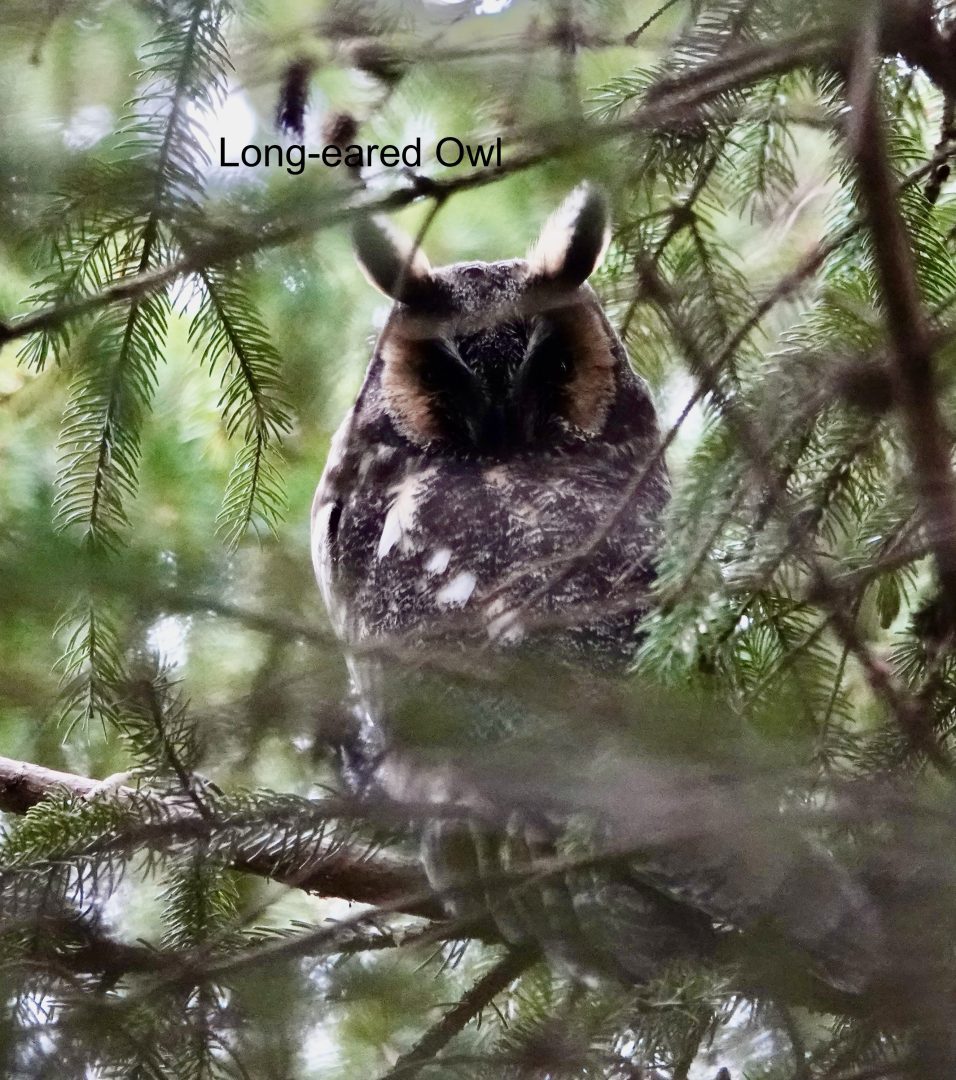
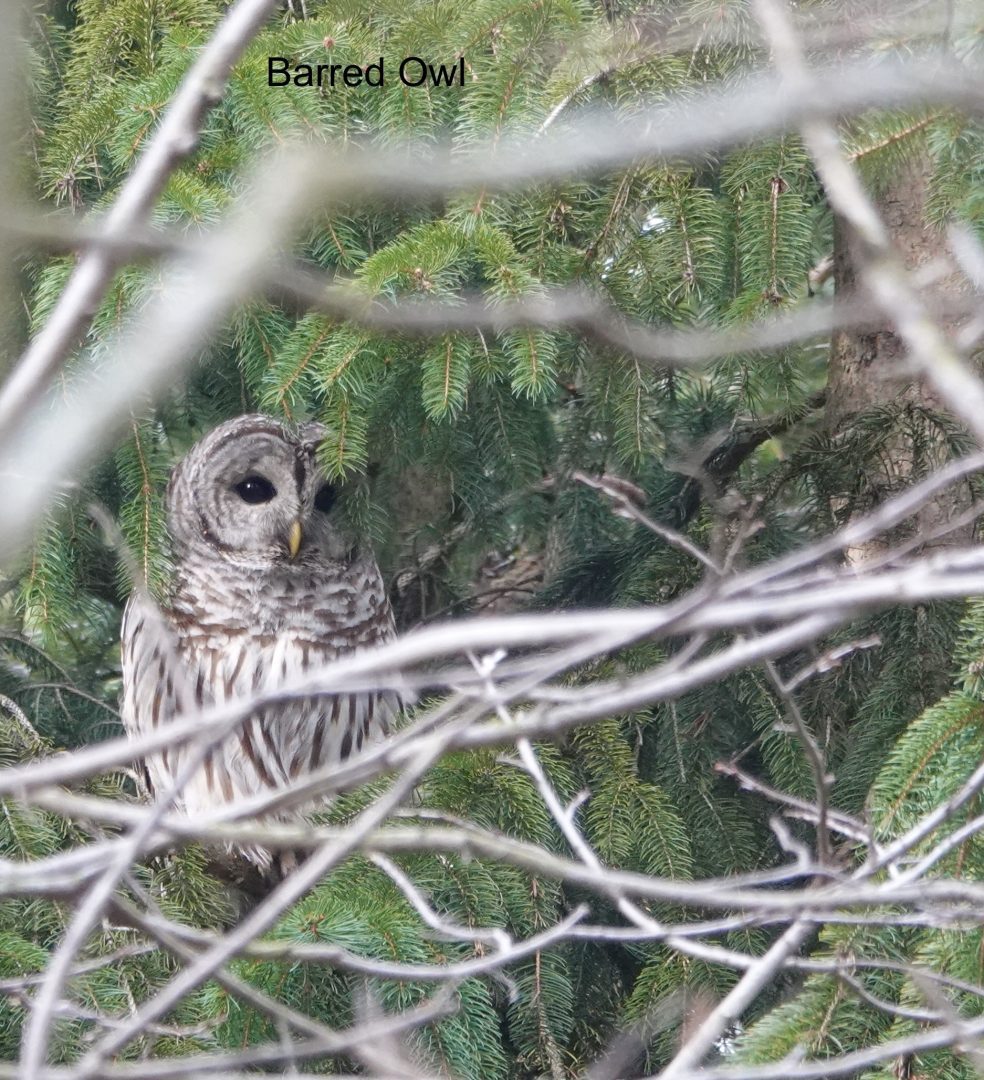
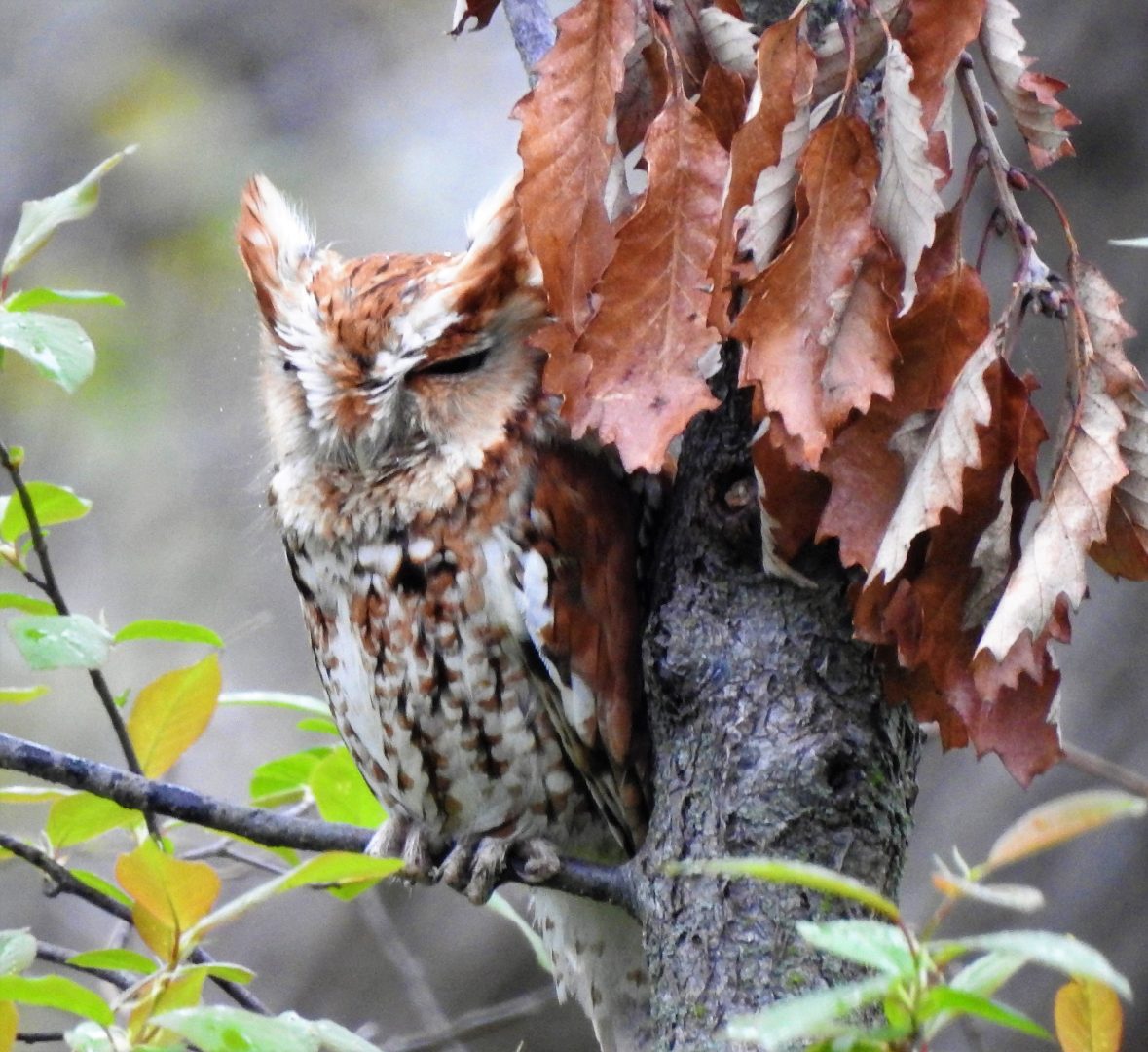
Normally we would start the new year on Lake Ontario ticking all the wintering ducks but this year we stuck with Brant county and tried to see all the wintering birds we could. By the end of February we had 70 species, including sightings and pictures of Long-eared, Barred, and Eastern Screech Owls, all seen in an eight day period.
And to be clear, we didn’t find the birds, we were told and shown where they were by other birders. You always will depend on the kindness of other birders to help you out, even if you are actively competing with each other. The birders in Brant always help each other even while we battle for those top spots.
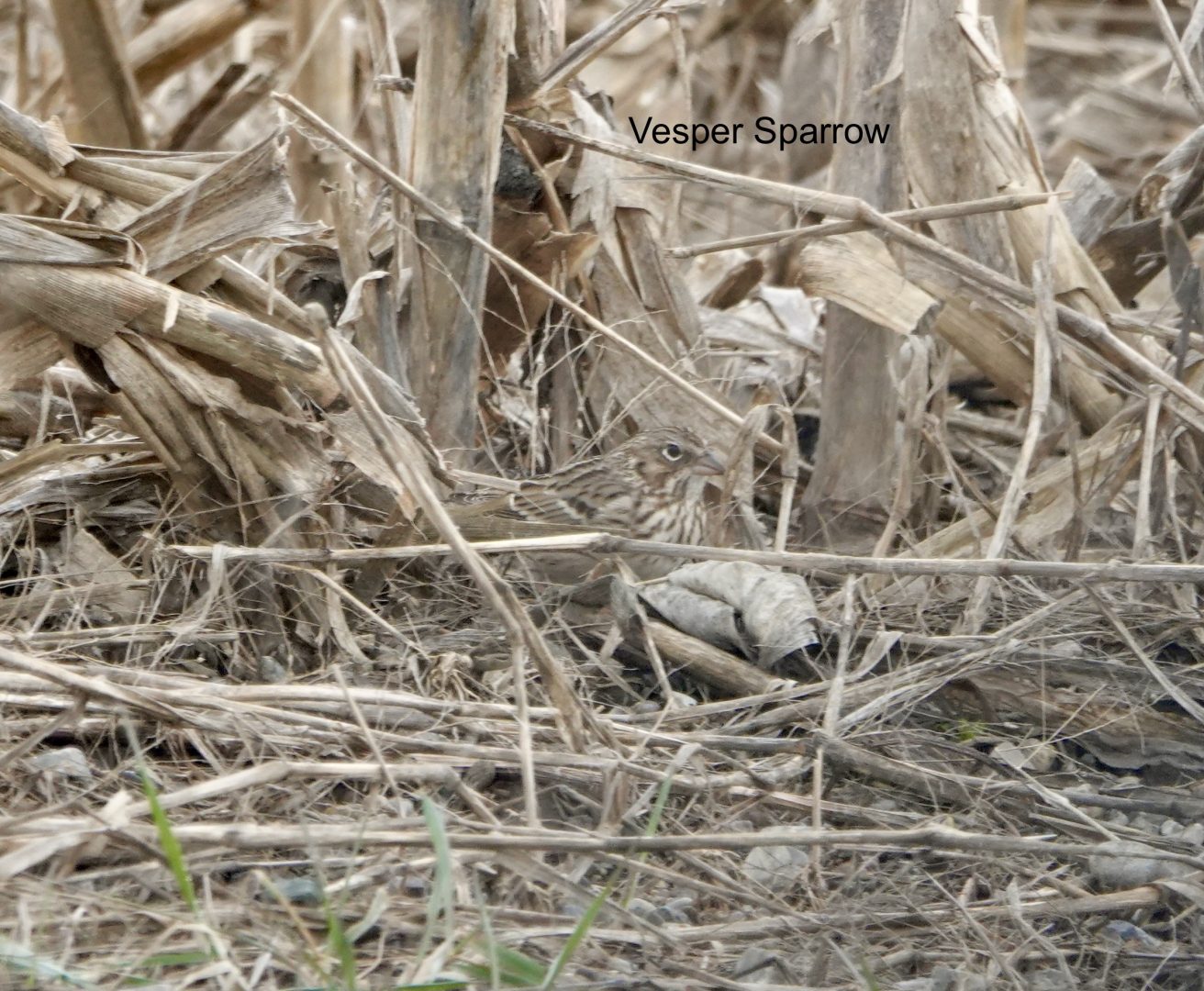
Our 100th species came on April 5, a Vesper Sparrow freshly arrived from the south to set up nesting for the summer. We took two weeks to head to Florida at the end of April to mop up some birds we missed on previous trips. May is the height of migration and the birds arrive fast and furious, despite still spending time at Pelee we managed to be at 184 by the end of May.
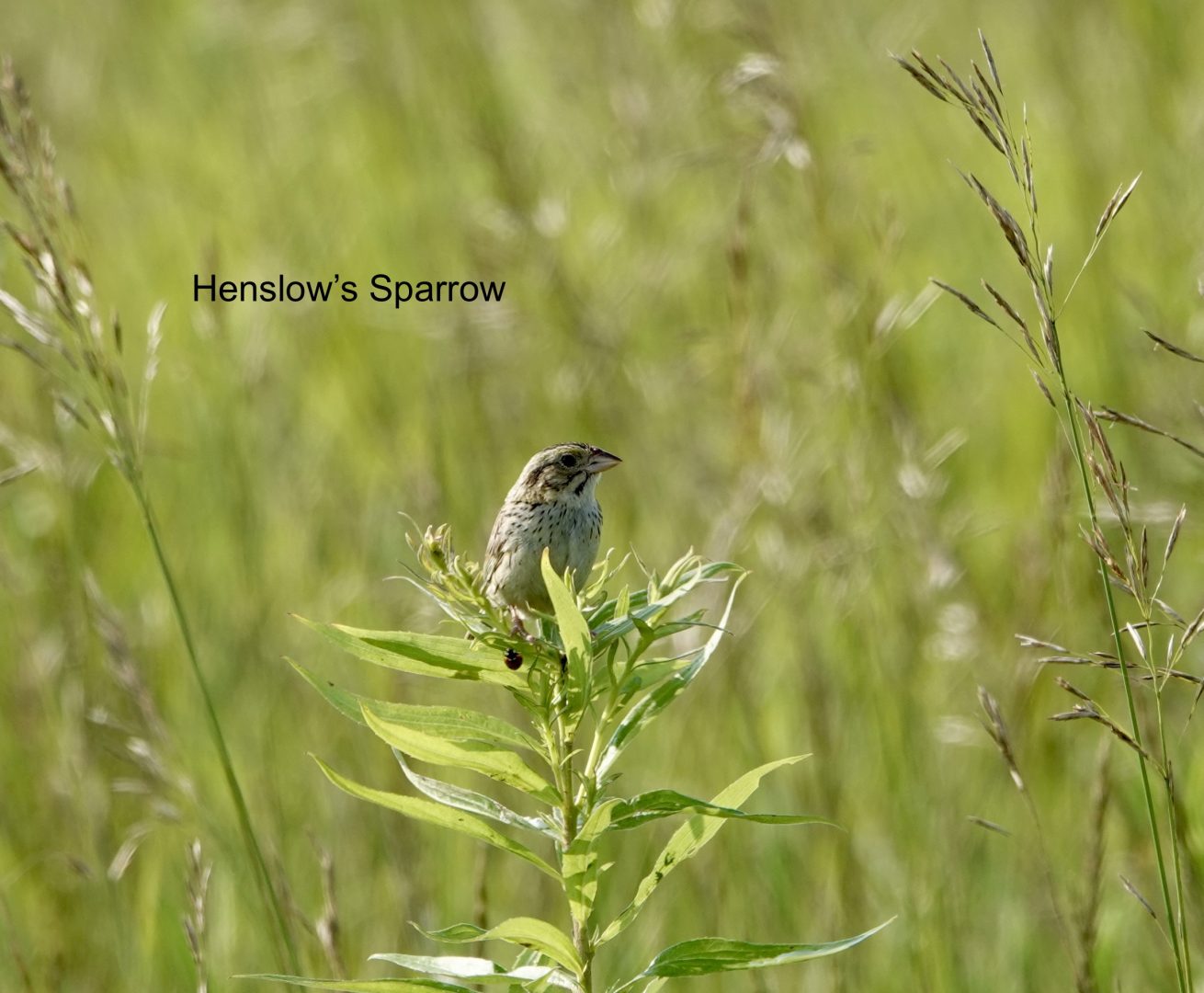
The birding slows in the summer, nesting birds are quieter, migration is over, the heat of July means quiet forests. We added only 6 birds in June AND July. August usually brings shorebirds but this summer was wet and lots of rain meant the ponds that are normally almost dry for the shorebirds still had very high water and so only 4 birds were added in August as the usual shorebirds passed over Brant County. Highlights from the summer were a rare Henslow’s Sparrow singing in a Conservation area close by. Only a few birders were made aware of this bird so as not to disturb it. A quick evening chase after a text from a fellow birder netted us a Black Tern, seen only a few minutes before it faded away in the twlight.
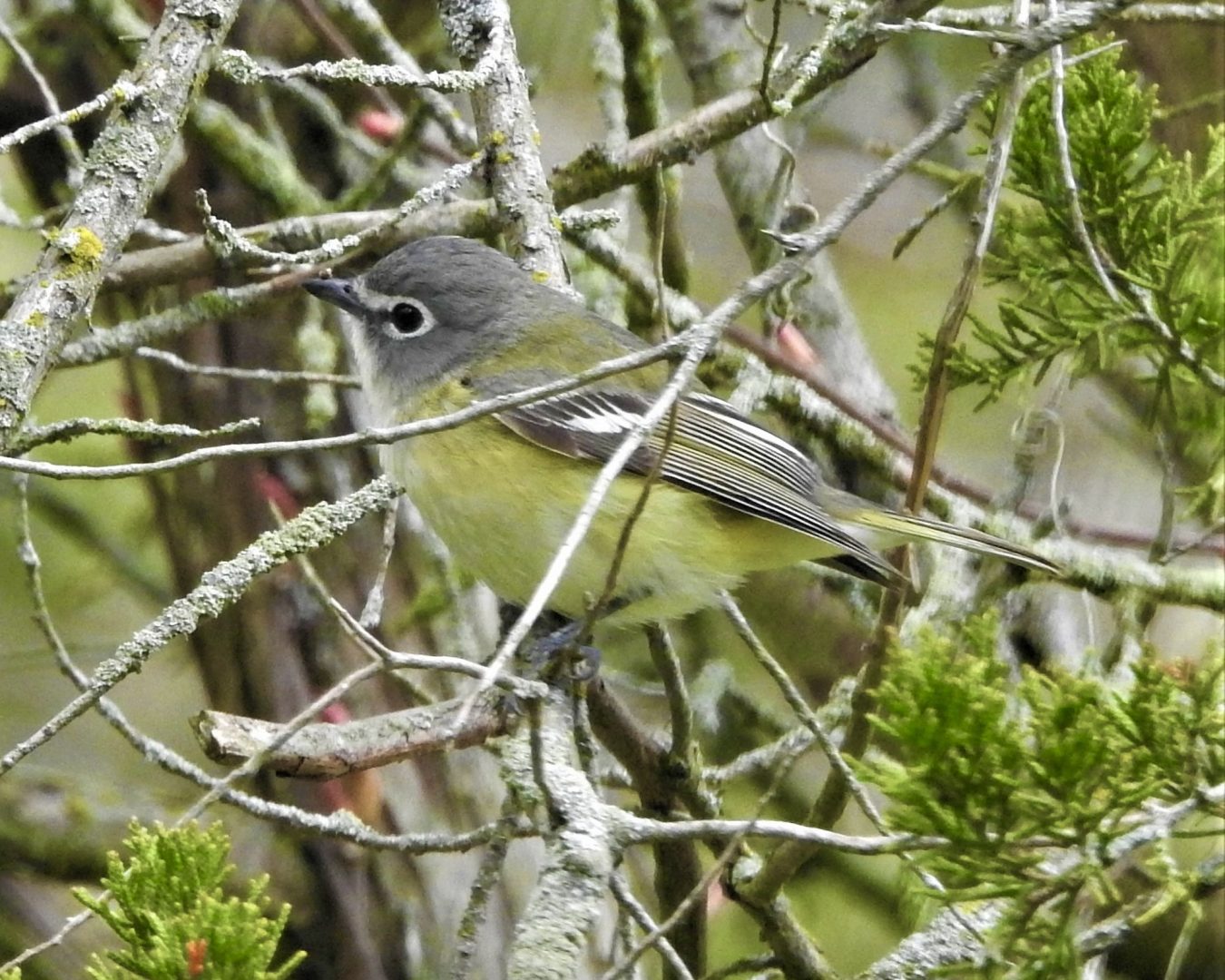
By August I had a list of the possible species I could still get and we started to focus on those birds, a few I missed in the spring and a few would arrive through fall migration. We were trying to bird every day for a least a few hours. I was at 194 after the Black Tern. Only 6 to go. The first two weeks of September yielded 5 more and suddenly I was at 199. I knew there were still many more possible species I would see, but what bird would be 200? On September 27 we headed to Brant Waterworks Park, a lovely trail system that takes hours to loop the 8kms. And there it was, way back off the trail but totally identifiable – Blue-headed Vireo! Number 200 and, as it happens, one of my favourite species. Jerry could not get a picture but this is a Blue-headed Vireo from another sighting.
Fifteen minutes later Jerry spotted something in the underbrush, had his camera up and said, Gray-cheeked Thrush. It was the other bird I was hoping to get , I quickly got bins on the area and saw movement after a bit but it was a Swainson’s Thrush. These two species are not an easy ID. When we first started birding we spent hours agonizing over which was which. We are much better now and more confident and Jerry was sure he saw a Gray-cheeked. I spent many more minutes sifting through numerous birds, there was one that was a possibility but I could not be sure with the bird staying in the shadows. Suddenly we were back in the same situation as last year, despite being his shadow, he was ahead of me by 1 bird, AGAIN! But this time I was not bothered (as much), I had my 200 birds!
This is where the honour system in birding plays a role. I could have just added Gray-cheeked too. I was standing right beside him, but I really didn’t see it. Each birder has to decide what they are comfortable doing or allowing on their list. I want to see the bird, hopefully enough to ID what it was, or hear it and recognize the song. If I had seen the bird fly away and Jerry said it was a Gray-cheeked I would have probably added it, but not seeing which bird he had seen meant I was not going to add it. Jerry and I birding together is a double-check for most things we see. We can question each other and we still, both of us, get excited and make wrong ID’s but usually with two people the chances are less.
I added another 5 birds in October and one nice rarity, a White-winged Crossbill in November moving the needle to 206 and 207 for Jerry. Now there were less possibilities left as November moved to December. I missed a Golden Eagle during their migration, I missed a rare Red Phalarope, kept dipping (missing) on a Norther Shrike although we checked out numerous Ebird sightings of them and drove areas multiple times where we had seen them in the past. December 17 and not a bird added since November 5. A birding slump I hoped would not continue into the new year.
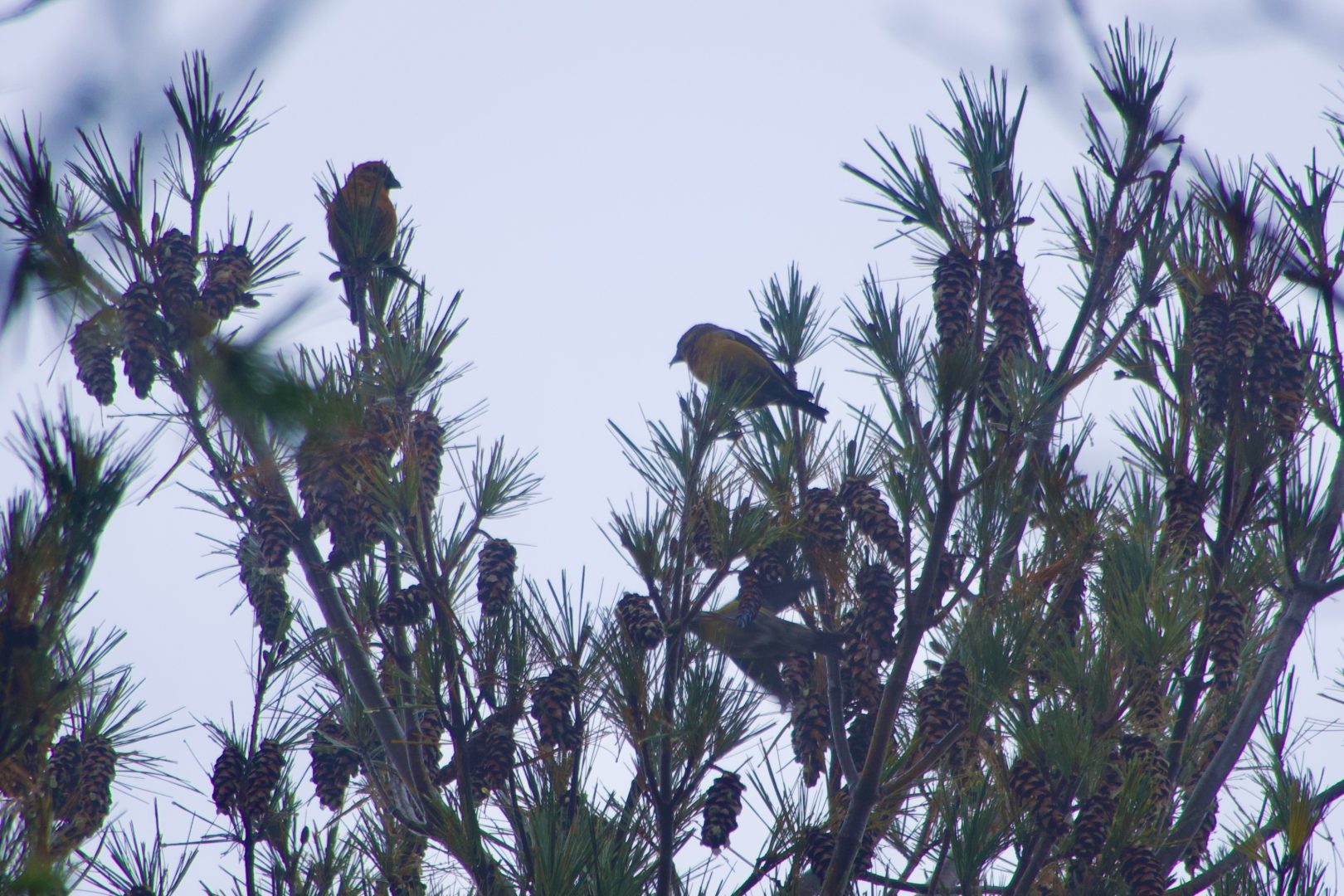
A Christmas miracle occurred and the slump was broken when we added Red Crossbill to our lists on December 25. It was our third attempt to see the birds, a rarity from the boreal forest. There were 20 calling and feeding in the spruce trees at a small Conservation spot just around the corner from home so we did not even have to travel far. Exciting, and the slump was over!
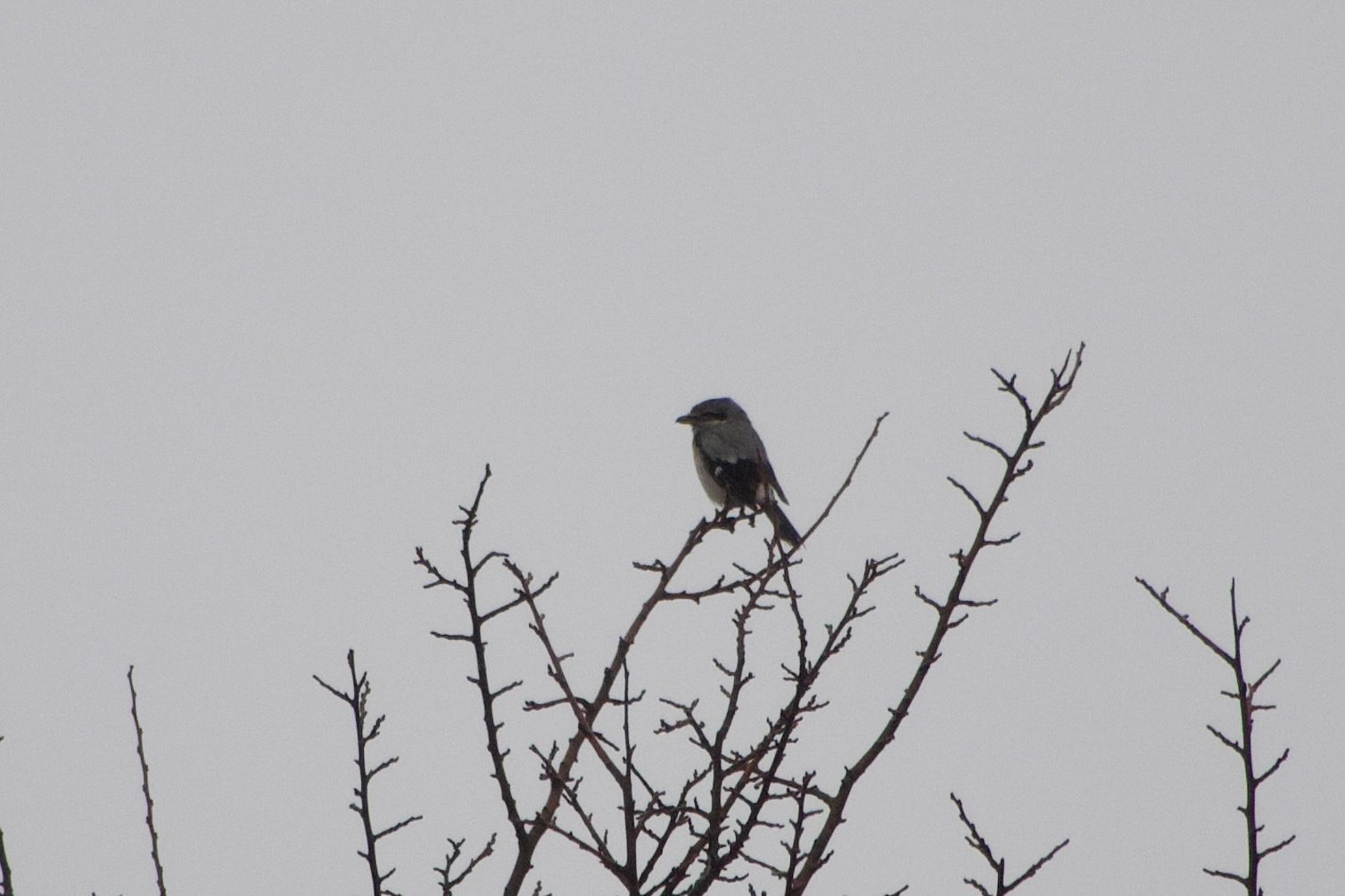
On Boxing Day we headed out in the drizzle for what felt like our 20th attempt at a Northern Shrike. We visited a site 10 minutes from home where there have been a number of reports and where we have looked a few times with no luck. As we headed into the field Jerry spotted it at the top of a bare tree, its normal behavior as it hunts small birds and mice, and just like that, two birds added in two days! There were a few high fives and woo-hoo’s happening!
On December 28 a report of a Little Gull hit the Discord channel for Brant and we went to have a look. We found the birds easily in a field with hundreds of gulls but sadly they were technically in Haldimand County. We were standing on the road that divides Brant and Haldimand. Once again the ethics of birding came into play and we counted them for Haldimand, not Brant County. I thought that might be the end for sightings but on the 29th a Long-tailed Duck was found and we saw it on the 30th to put us finally at 209 and 210.
Brant County had 231 species seen this year with a tie for the top birder between Bill Lamond and Jason Pizzey with 221 seen. Jerry was second with 210 and myself and Jenny Pizzey in 3rd with 209. We saw 90% of the birds seen in 2023. I’m well satisfied with that number. Onto Ontario and 300.
Back in 2013 when we first started listing, we did it under the premise of a “Big Year” as a bit of a joke. It was a goal to get us off the couch and get back out into nature. We traveled with a hard cover book in our backpack and cheap binoculars. We sometimes spent hours on a trail flipping through the book trying to find a match to the bird we were seeing in front of us. We had no idea of how many species actually passed through Ontario. We signed up with the Ontario Field Ornithologists and the Hamilton Naturalists Club and went on walks and listened to all these expert birders soaking in as much knowledge as we could. At the end of the year we had seen 210 birds in Ontario and 81 of them were lifers (a species seen for the first time).
Now 11 years later, we will start a proper Big Year with a goal of seeing over 300 species, the accepted benchmark for Big Years in Ontario. In any given year around 370 species are seen in Ontario with 300 being about 81% of the total. I’ve spent the last few months creating excel spread sheets, calendars, and lists to figure out how best to tackle getting to 300. There are many tools at my disposal now that provide a plethora of information making the job of finding a specific bird easier than ever before.
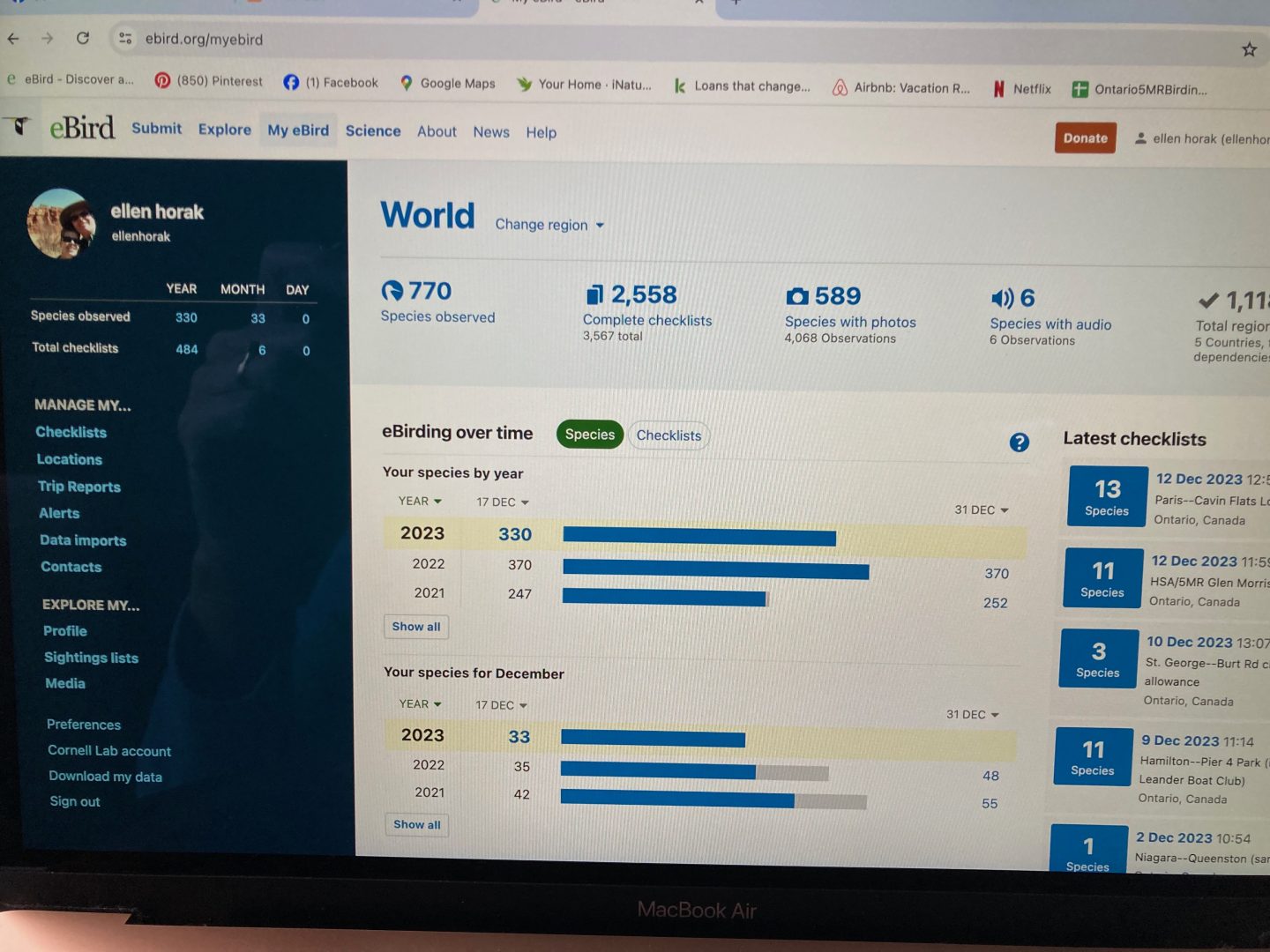
Ebird is a fantastic free resource that allows any birder to upload what birds they see and allows others to see those lists. There are 935,000 birders worldwide using Ebird and they have added 87 million complete checklists for 10,829 species of birds in the world. I don’t plan any trips without doing the research on Ebird of what birds I can see and where I can see them. Ebird also keeps track of all your sightings and totals for county, province, county, continent and world as well as specific patches you can set up, like your backyard. When we started in 2013 we used paper and pencil to note the birds we saw and now the ebird app is on our phones. Ebird also tracks the top 100 birders for all those geographic areas. Ebird is where I started my research for Ontario.
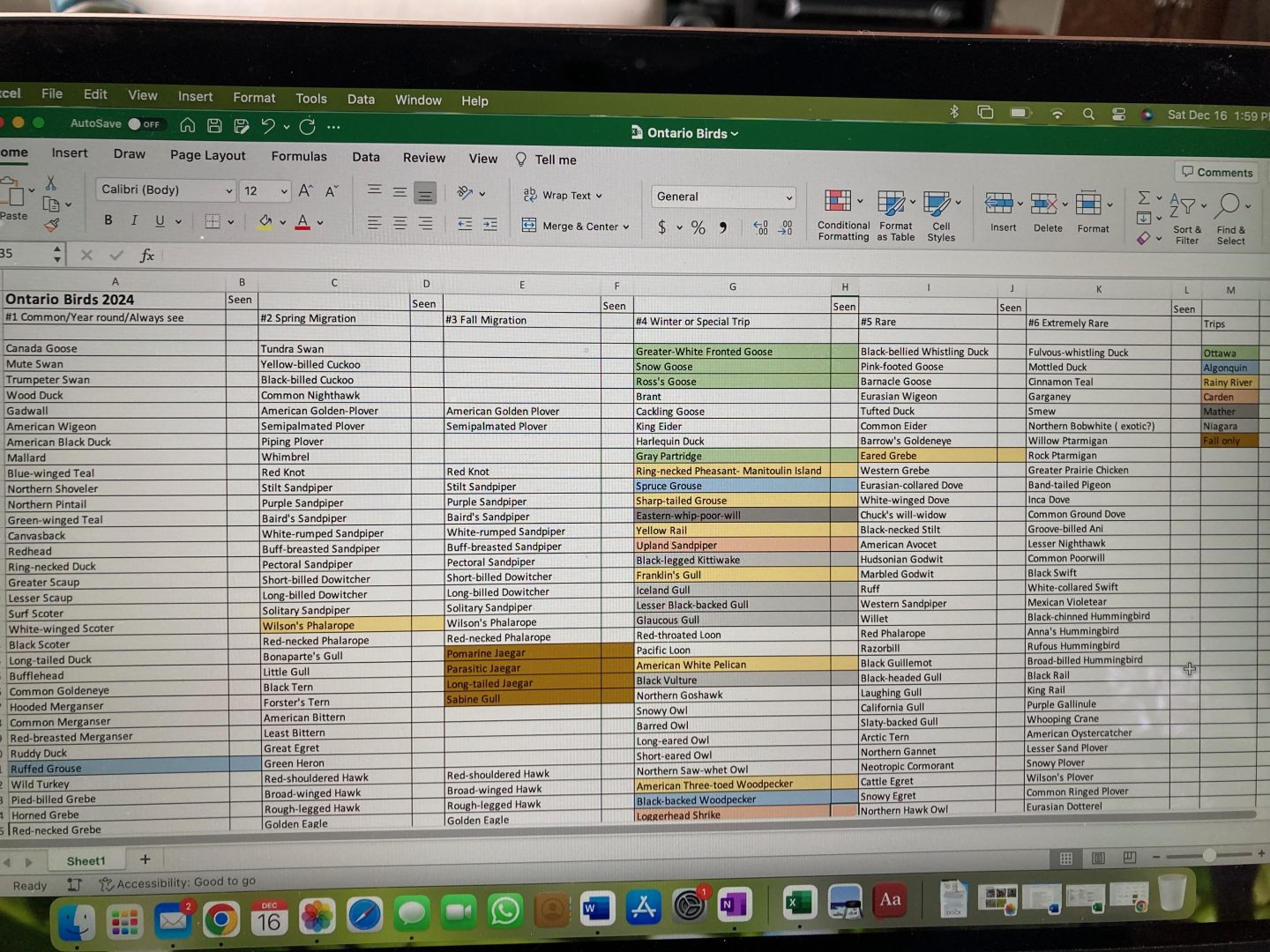
Usually, birders will start with ranking the birds from easiest to see to the most difficult. I ranked mine a bit differently. I have an excel sheet with 142 birds ranked as the common easy birds to see without any extra effort other than be out birding. Then I ranked another 86 birds seen during spring migration. Most of these same birds will come through again in the fall giving us a second chance to get any we miss in the spring as well as 5 birds that are usually only seen in the fall. We also have the chance to catch some of these birds (warblers) on their nesting grounds if we don’t mind battling mosquitoes. Then there are about 55 birds that we need to make special trips to get and usually end up seeing or hearing. These trips are to Algonquin Park, Carden Alvar, Rainy River, Ottawa, Northern Ontario, Amherst Island. Those lists total 288 leaving me with needing to see at least 12 rarities to get to the 300 IF I see every single one of the 288, and realistically, most years, there is a bird or two that you just don’t seem to be able to track down. Birds are fickle that way, they do not care you are doing a Big Year. Despite our knowledge, technology, social media for instant contact of a rarity, it still comes down to timing. The bird has to be there when you are there. Luckily, there are usually 40 rarities that show up in any given year giving me plenty of chances to get past the 300. Unfortunately, most of the rarities also show up in May when we will be trying to get all the spring migrants coming through Pelee. There will be some tough choices to make about what to chase and where to be, come May.
The strategy for most Big years is to start the year getting as many rarities that are hanging around first. Chase, chase, chase will be the first week in January, assuming there are rarities to chase. We will see the common birds as we chase the rarities. I am currently monitoring the rarities in the province to see what ones might still be around January 1 and then we will head to the rarest of these first and then to any others that remain. My strategy is to try and bird the area for the day or even two days when we chase a rarity rather than just drive hours for one bird. I want to try and be somewhat “green” in our approach, while fully aware that chasing birds around the province is not a “green” activity at all. Hey, we drive a plug-in hybrid so its a bit more green…
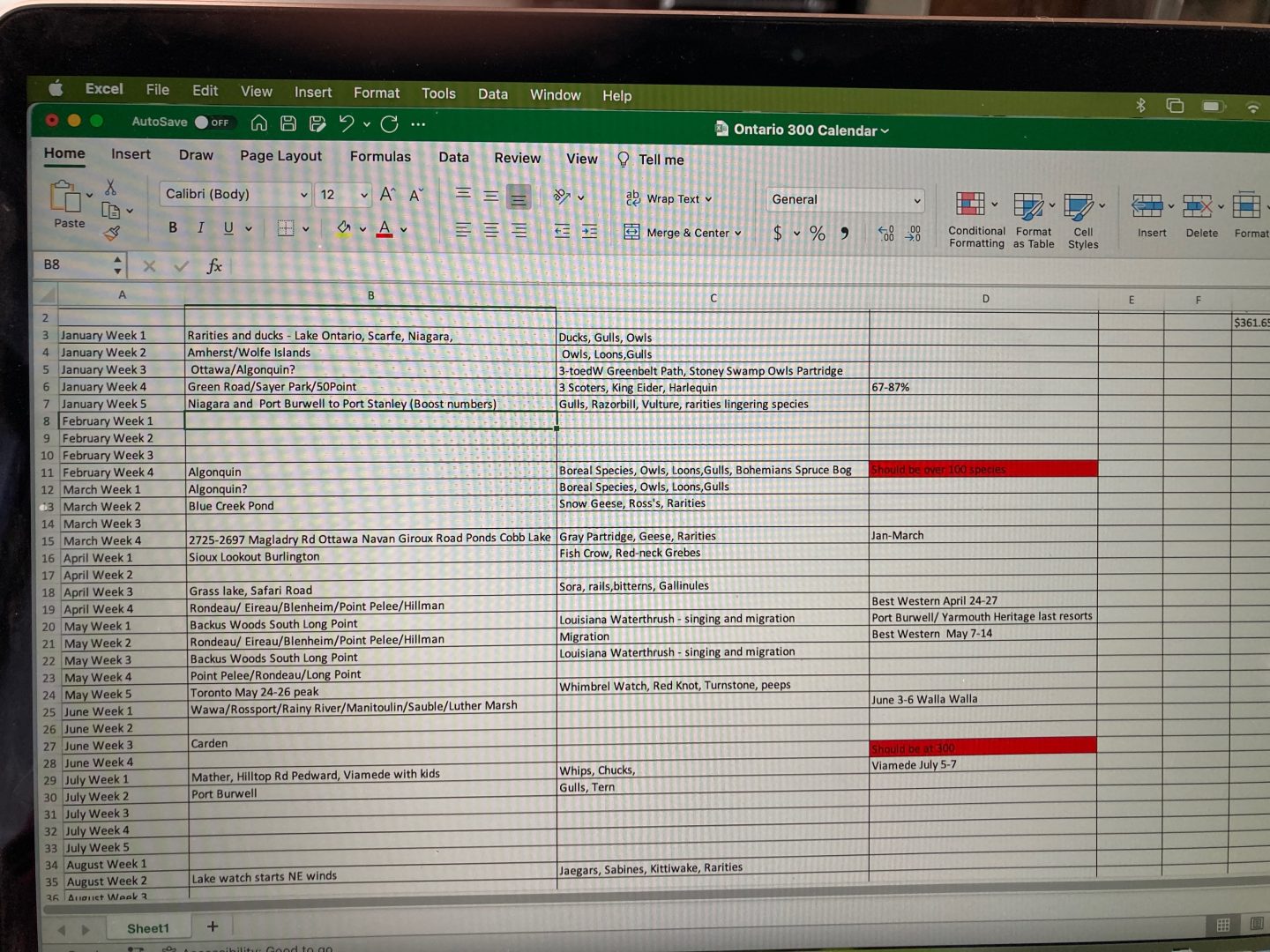
As well as the ranking of birds I have a calendar in Excel detailing each week with notes as to what species might be seen at a particular time. Many migrating species only pass through Ontario in a narrow window and I cannot afford to miss those species. An example is the Whimbrels that migrate through Toronto every year with their peak numbers May 24-26. While you can see them elsewhere along the lakes, it is sporadic and random so guess where I will be on May 24?
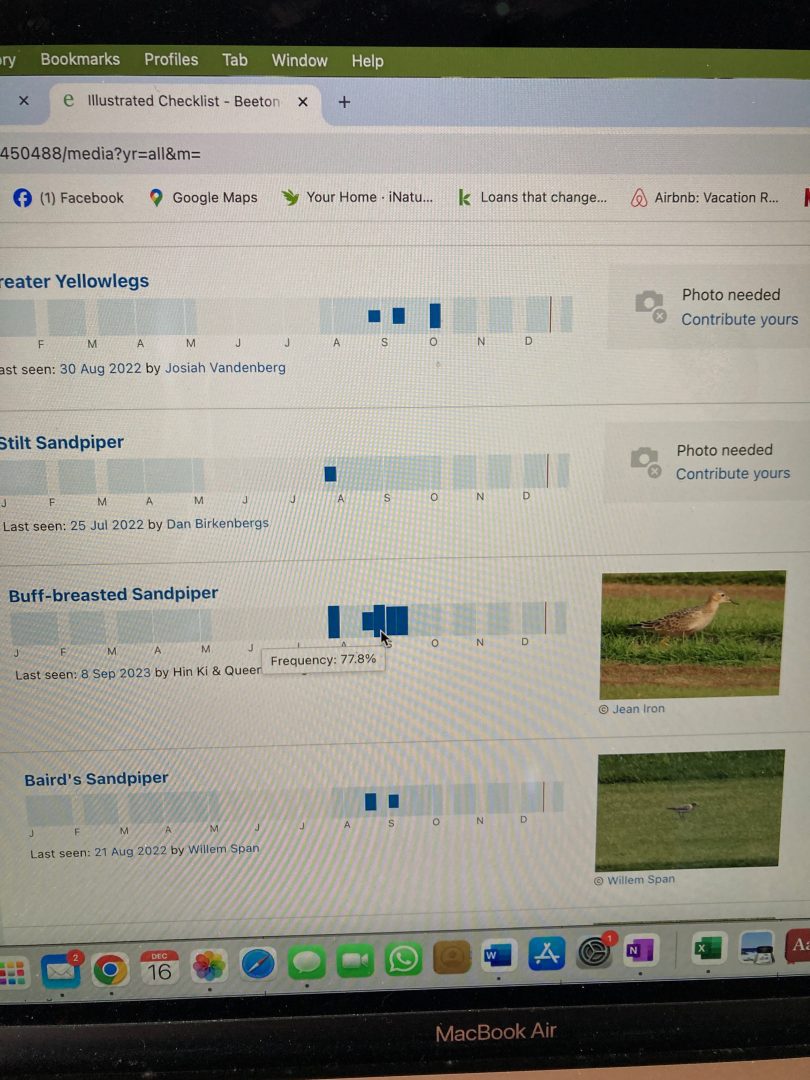
The next research was to put together a Word document and look at each uncommon species and find out the best place in the province with the highest probability to see the bird. Ebird helps with this with their illustrated checklist for every birding hotspot showing the species you expect to see each week of the year and the percentage probability of the bird being there. As an example, Buff-breasted Sandpiper migrates through in August and sometimes we can see one a short distance from home but it is not reliable and it’s usually a very poor scope view so my research tells me that I have a 77.8% chance of seeing one on 10th Line in Beeton the 4th week in August. That info is now on my excel calendar and the word document of Birds to Chase.
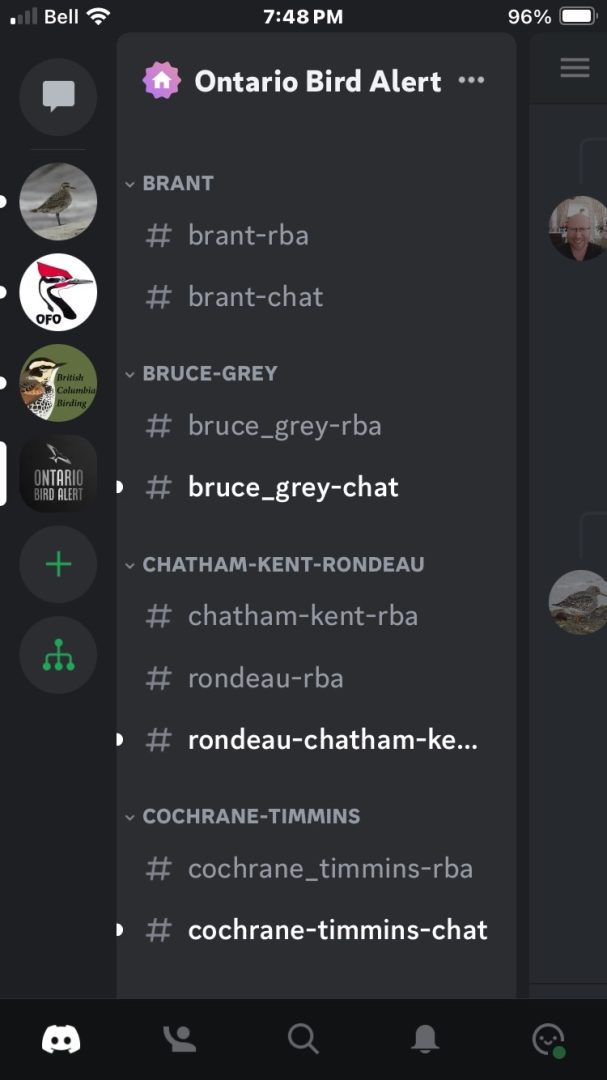
Another indispensable tool for birding is our Ontario Bird Alert on the Discord App. The App was started, I believe, for video gamers to be able to chat with each other while they gamed and I assume a birder thought it might be used for another purpose – sharing rarities and information to the second about where birds are being seen. Posters can share a pin to the exact location they are currently seeing the bird, info about parking and trail conditions and info about visitation rules if a bird is at a private residence. It was a game changer for the birding community.
I have signed up for notifications for all the rare bird alerts for each county in Ontario and will be monitoring what people are posting. In this way, a Big Year is not a solitary endeavour. I will be very dependant on other birders finding cool rarities so that I can try and “chase” or “twitch” them. I have also signed up for Ebird emails detailing rarities posted as not all birders use Discord and I will also get an email with a list of birds I still need to see within Ontario and where the bird is being seen.
The tools Jerry and I take into the field have changed from 2013. Iphones are now indispensable with apps to record our checklists on Ebird, Discord for alerts, and Sibleys and IBird Pro field guides in an app. We also use Merlin for identifying bird calls around you while you hike. It is not 100% accurate but it can alert you to a bird that you do not know the call for, and we do not know most of the bird calls. We never use Merlin as our only source to add a bird to a check list. We always have to hear or see the bird ourselves and confirm the song.
We both have Vortex HD Razor 8×42, an excellent binocular with a lifetime guarantee. A good thing as Jerry is on his 3rd pair in 6 years, having damaged 2 pairs in falls. Our scope is a used Swarovski that still competes with the best scopes our there. Jerry has updated his camera a few times since 2013 and now uses a Sony RX10 for photographs and with its long zoom doubles as a scope when we are hiking if a bird is out of our binocular range. I use the Nikon Coolpix P900 for video. The plan is to get a picture/video or audio of every bird we see next year.
The planning is done, the equipment ready, the countdown to January 1 has begun….
I have been intrigued with the idea of Big Years since first reading and then seeing the movie The Big Year, starring Steve Martin, Jack Black and Owen Wilson way back. A big year is a personal challenge among birders to identify as many species of birds by sight or sound in a single calendar year and a certain geographic area. It is on the honour system so many birders try to capture a picture of all the birds they see for irrefutable proof. I’m naturally competitive and it has a crazy kind of appeal BUT I know trying to break records would not be good for my mental and physical health. The stress I would put myself under would no doubt end in someone’s death LOL and not necessarily my own! Still many birders choose not to try for the records and to just compete against themselves with arbitrary rules. So, early this year I came up with an idea, three consecutive Big Years of 200, 300, and 400. Two hundred species seen in Brant County in year 1, three hundred species in Ontario in year 2 and four hundred species seen in Canada in year 3. Crazy huh? But cool, right? They say when you are retired you need to have goals!
Back in 2013 when we started listing, only 187 species of birds were seen in Brant County and the highest ebirder had only 113 species! There are not a lot of birders in Brant County so those of us here have taken on the mission to bird more in the county. It was not until 2016 that 206 species were seen in the county and the top birder was still only seeing 164. Finally in 2020 there were 234 species seen with 3 birders over 200 and then in 2021 Bill Lamond saw 226 out of the 237 birds seen! Since then there are usually 4-5 birders that manage to hit the 200 mark. Not super hard, but it requires a lot of days birding, in a small geographic area and you have to chase rarities in order to hit the 200. I have seen over 200 species this year and I’ll tell that story in another blog…
In Ontario there is a large population of birders (thousands) who are super keen and 300 species is the benchmark for many Big Years. In any given year there are around 370 species seen in Ontario and most years 10-12 people hit the 300. In 2022 many people decided to do Big Years (covid ended) so there were a record 21 people over 300 and a new record set of 359 species seen by Kiah Jasper. This year the numbers are back to the norm with 14 birders hitting the 300 mark so far and the top birder seeing 328 species.
You would think that if you can get 300 in Ontario then 400 across Canada would be easy but the larger the geographic area the harder to physically get to the birds. Plus, the birds you need, inevitably, are seen in the other provinces at the same time so you need to make decisions about when to hit spring migration in British Columbia without missing too much of spring migration in Ontario. I’m also not planning on getting on planes to chase a rare bird in BC only to hear of another in Newfoundland so 400 will be a real challenge with just driving across Canada to the east and to the west. In Canada 530 species are usually seen and in most years only 1-4 people manage to cross the 400 mark. Currently an astonishing new record is being set by Bruce DiLabio with 480 species seen and he is the only birder over 400. The previous record was 457! It’s a vast territory to cover and will be the most challenging year for sure.
My previous best numbers for these three locations happened in 2022 because we travelled out west and birded along the way.
Brant County 199 species
Ontario 285 species
Canada 370 species
See, I have been close to the 200,300, and 400 and they are completely doable with lots of planning and good birding karma coming back to us.