Before the birding begins – The Planning and Tools for a Big Year
Back in 2013 when we first started listing, we did it under the premise of a “Big Year” as a bit of a joke. It was a goal to get us off the couch and get back out into nature. We traveled with a hard cover book in our backpack and cheap binoculars. We sometimes spent hours on a trail flipping through the book trying to find a match to the bird we were seeing in front of us. We had no idea of how many species actually passed through Ontario. We signed up with the Ontario Field Ornithologists and the Hamilton Naturalists Club and went on walks and listened to all these expert birders soaking in as much knowledge as we could. At the end of the year we had seen 210 birds in Ontario and 81 of them were lifers (a species seen for the first time).
Now 11 years later, we will start a proper Big Year with a goal of seeing over 300 species, the accepted benchmark for Big Years in Ontario. In any given year around 370 species are seen in Ontario with 300 being about 81% of the total. I’ve spent the last few months creating excel spread sheets, calendars, and lists to figure out how best to tackle getting to 300. There are many tools at my disposal now that provide a plethora of information making the job of finding a specific bird easier than ever before.
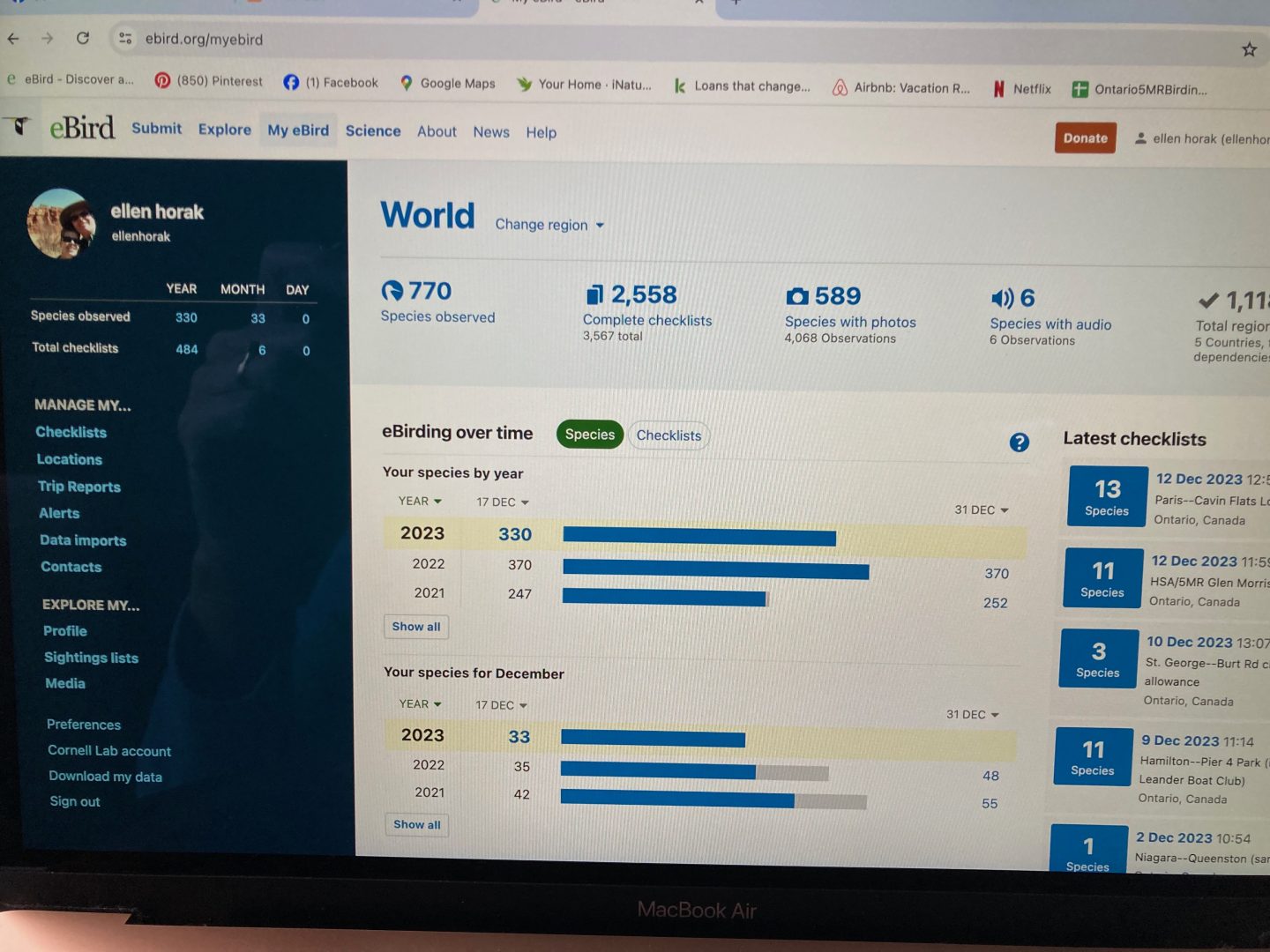
Ebird is a fantastic free resource that allows any birder to upload what birds they see and allows others to see those lists. There are 935,000 birders worldwide using Ebird and they have added 87 million complete checklists for 10,829 species of birds in the world. I don’t plan any trips without doing the research on Ebird of what birds I can see and where I can see them. Ebird also keeps track of all your sightings and totals for county, province, county, continent and world as well as specific patches you can set up, like your backyard. When we started in 2013 we used paper and pencil to note the birds we saw and now the ebird app is on our phones. Ebird also tracks the top 100 birders for all those geographic areas. Ebird is where I started my research for Ontario.
Usually, birders will start with ranking the birds from easiest to see to the most difficult. I ranked mine a bit differently. I have an excel sheet with 142 birds ranked as the common easy birds to see without any extra effort other than be out birding. Then I ranked another 86 birds seen during spring migration. Most of these same birds will come through again in the fall giving us a second chance to get any we miss in the spring as well as 5 birds that are usually only seen in the fall. We also have the chance to catch some of these birds (warblers) on their nesting grounds if we don’t mind battling mosquitoes. Then there are about 55 birds that we need to make special trips to get and usually end up seeing or hearing. These trips are to Algonquin Park, Carden Alvar, Rainy River, Ottawa, Northern Ontario, Amherst Island. Those lists total 288 leaving me with needing to see at least 12 rarities to get to the 300 IF I see every single one of the 288, and realistically, most years, there is a bird or two that you just don’t seem to be able to track down. Birds are fickle that way, they do not care you are doing a Big Year. Despite our knowledge, technology, social media for instant contact of a rarity, it still comes down to timing. The bird has to be there when you are there. Luckily, there are usually 40 rarities that show up in any given year giving me plenty of chances to get past the 300. Unfortunately, most of the rarities also show up in May when we will be trying to get all the spring migrants coming through Pelee. There will be some tough choices to make about what to chase and where to be, come May.
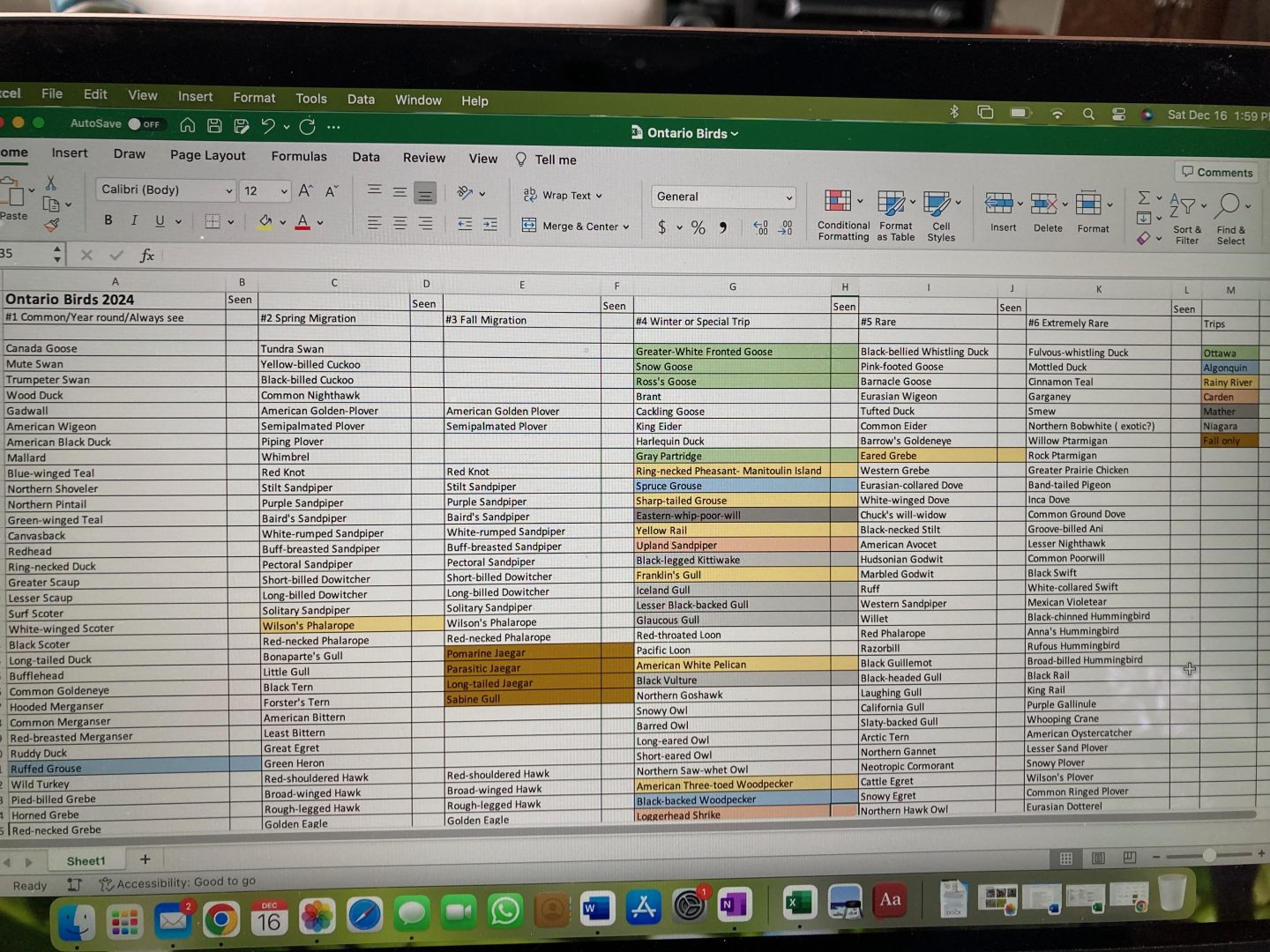
The strategy for most Big years is to start the year getting as many rarities that are hanging around first. Chase, chase, chase will be the first week in January, assuming there are rarities to chase. We will see the common birds as we chase the rarities. I am currently monitoring the rarities in the province to see what ones might still be around January 1 and then we will head to the rarest of these first and then to any others that remain. My strategy is to try and bird the area for the day or even two days when we chase a rarity rather than just drive hours for one bird. I want to try and be somewhat “green” in our approach, while fully aware that chasing birds around the province is not a “green” activity at all. Hey, we drive a plug-in hybrid so its a bit more green…
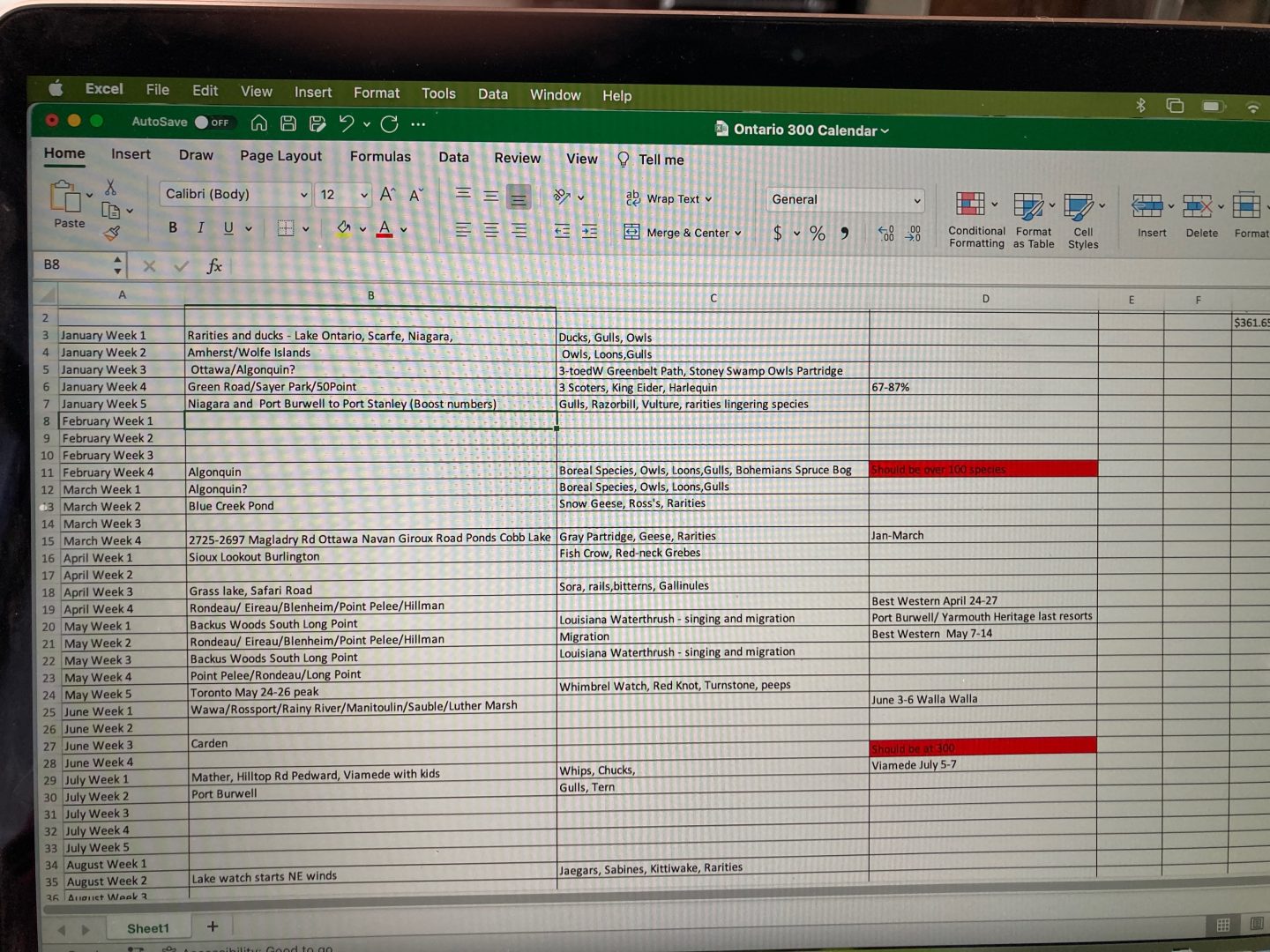
As well as the ranking of birds I have a calendar in Excel detailing each week with notes as to what species might be seen at a particular time. Many migrating species only pass through Ontario in a narrow window and I cannot afford to miss those species. An example is the Whimbrels that migrate through Toronto every year with their peak numbers May 24-26. While you can see them elsewhere along the lakes, it is sporadic and random so guess where I will be on May 24?
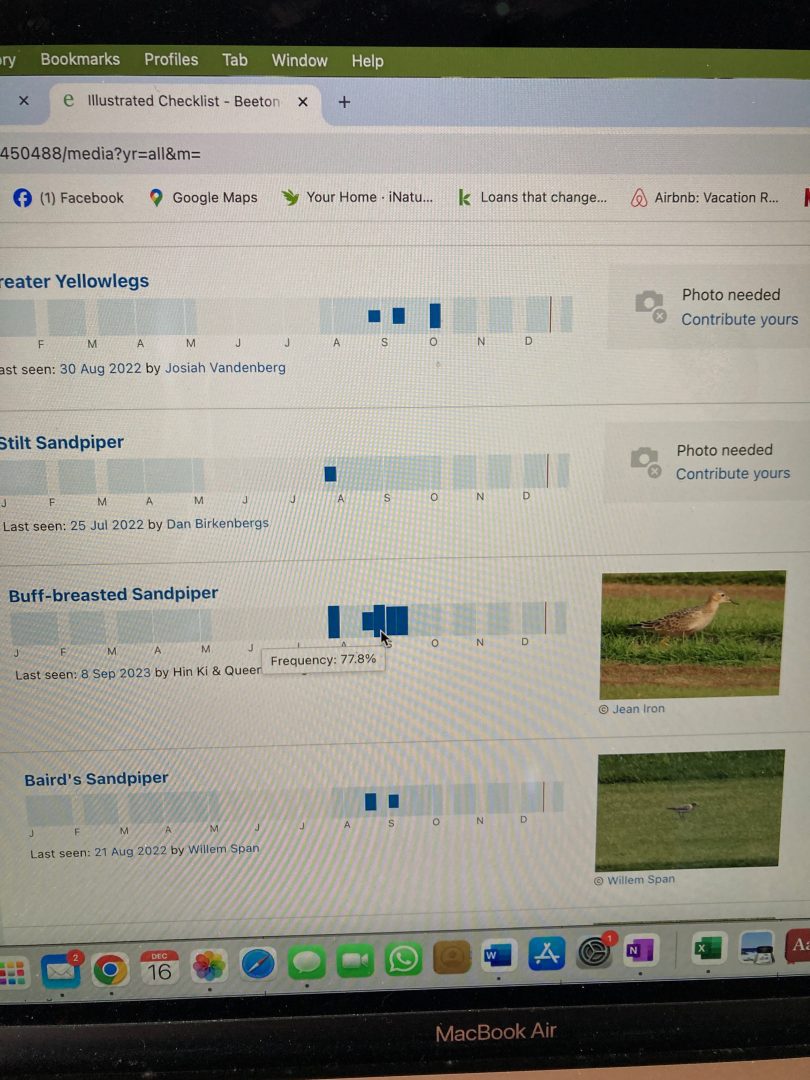
The next research was to put together a Word document and look at each uncommon species and find out the best place in the province with the highest probability to see the bird. Ebird helps with this with their illustrated checklist for every birding hotspot showing the species you expect to see each week of the year and the percentage probability of the bird being there. As an example, Buff-breasted Sandpiper migrates through in August and sometimes we can see one a short distance from home but it is not reliable and it’s usually a very poor scope view so my research tells me that I have a 77.8% chance of seeing one on 10th Line in Beeton the 4th week in August. That info is now on my excel calendar and the word document of Birds to Chase.
Another indispensable tool for birding is our Ontario Bird Alert on the Discord App. The App was started, I believe, for video gamers to be able to chat with each other while they gamed and I assume a birder thought it might be used for another purpose – sharing rarities and information to the second about where birds are being seen. Posters can share a pin to the exact location they are currently seeing the bird, info about parking and trail conditions and info about visitation rules if a bird is at a private residence. It was a game changer for the birding community.
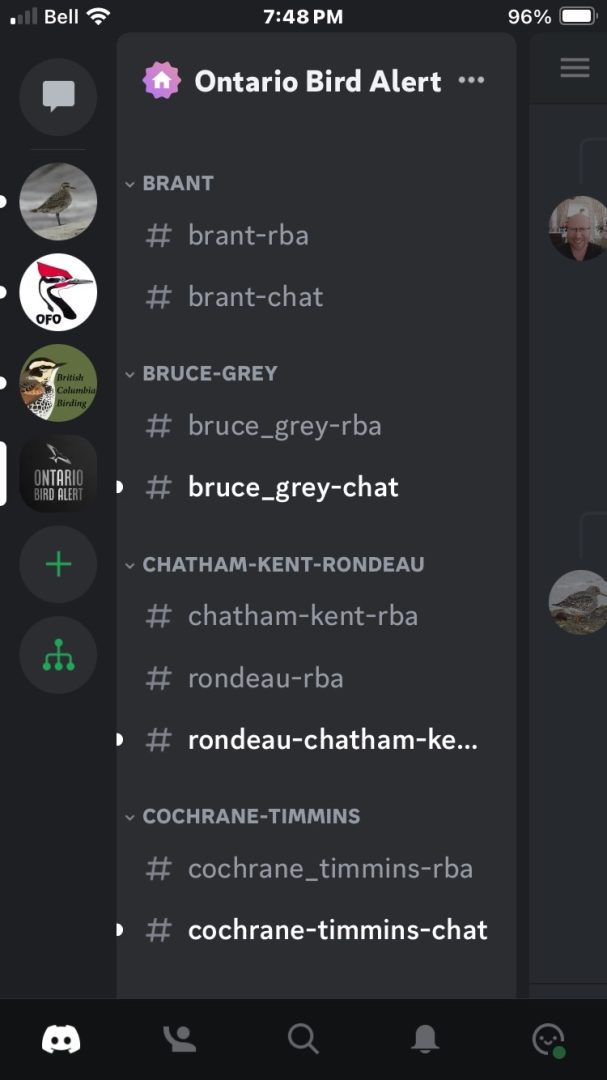
I have signed up for notifications for all the rare bird alerts for each county in Ontario and will be monitoring what people are posting. In this way, a Big Year is not a solitary endeavour. I will be very dependant on other birders finding cool rarities so that I can try and “chase” or “twitch” them. I have also signed up for Ebird emails detailing rarities posted as not all birders use Discord and I will also get an email with a list of birds I still need to see within Ontario and where the bird is being seen.
The tools Jerry and I take into the field have changed from 2013. Iphones are now indispensable with apps to record our checklists on Ebird, Discord for alerts, and Sibleys and IBird Pro field guides in an app. We also use Merlin for identifying bird calls around you while you hike. It is not 100% accurate but it can alert you to a bird that you do not know the call for, and we do not know most of the bird calls. We never use Merlin as our only source to add a bird to a check list. We always have to hear or see the bird ourselves and confirm the song.
We both have Vortex HD Razor 8×42, an excellent binocular with a lifetime guarantee. A good thing as Jerry is on his 3rd pair in 6 years, having damaged 2 pairs in falls. Our scope is a used Swarovski that still competes with the best scopes our there. Jerry has updated his camera a few times since 2013 and now uses a Sony RX10 for photographs and with its long zoom doubles as a scope when we are hiking if a bird is out of our binocular range. I use the Nikon Coolpix P900 for video. The plan is to get a picture/video or audio of every bird we see next year.
The planning is done, the equipment ready, the countdown to January 1 has begun….