Pelee Target Birds: Last week my targets were the Avocet and Willet. My targets now are birds that tend to overshoot their nesting grounds, show up at Pelee and then, I assume, return south not to be seen again. I don’t get a second chance at these species in the fall so they are the birds I am most after. Worm-eating Warbler, Kirtland’s Warbler, Kentucky Warbler, Yellow-throated Warbler, Summer Tanager and Yellow-breasted Chat. There is also the rare Chuck’s-will-widow and the Henslow’s Sparrow. I saw the Kentucky on Saturday evening so one is already off the list.
Sunday morning we were in Pelee National Park at 6:15 and at the Tip by 7am. It was a bit rainy but clearing once we got to the Tip. There are two reasons to go to the Tip each morning – to see if any new migrants have arrived and to witness what is called “reverse migration”. It is still not known why birds do this but many birds will fly repeatedly back off the tip and then circle back to land and then reverse off again. You would think they would be happy to have arrived and be tired from the flight across the lake. Birders stand with their backs to the tip and watch the birds as they head off the tip and try to ID as many as possible in flight. Many birders have telephoto lens cameras to take pics and determine species. Many of us have rarities on our birding lists from these reverse migrations as long as you actually get on the bird they are identifying.
Despite south winds it did not appear that many new migrants had come in but there was a bit of a reverse migration. We stuck around only for an hour or so and then started working our way up through the Park. A report came in to watch for a possible rare Bell’s Vireo and as I walked up the path I could see what looked like a vireo, I called over to other birders and Jerry got on the vireo to see that it was a White-eyed Vireo and then Barb looked at a bird beside it and yelled Prairie! A Prairie Warbler is one of the tougher warblers to find so we were happy to have that one added to the list and to see these two colourful birds beside each other. We found a few more warblers and common migrants to add to the list. A rainstorm at lunch kept us from birding for a bit and then we needed to check into our hotel for the week so it was not all birding. We went back into the park for the evening and ended the day having walked 17 kms and added 11 species to our list.


Monday morning found us at the Tip again with much better lighting than Sunday and way more of a reverse migration and obvious new migrants in the park. Group after group left the tip to fly out over the lake and circle around. One of the best was from the Red-headed Woodpeckers, as many as 11-12 kept flying off and then returning to a tree and then flying off again. I have never put that many Red-headed Woodpeckers on my list. Warblers, Gnatcatchers, Blue Jays, Red-winged Blackbirds all were reversing off the Tip. Despite a very good reverse migration we did not see any rarities reverse off. A Cerulean Warbler was spotted along the beach and everyone got a chance to see and photograph her. Another difficult and highly prized warbler to usually see.

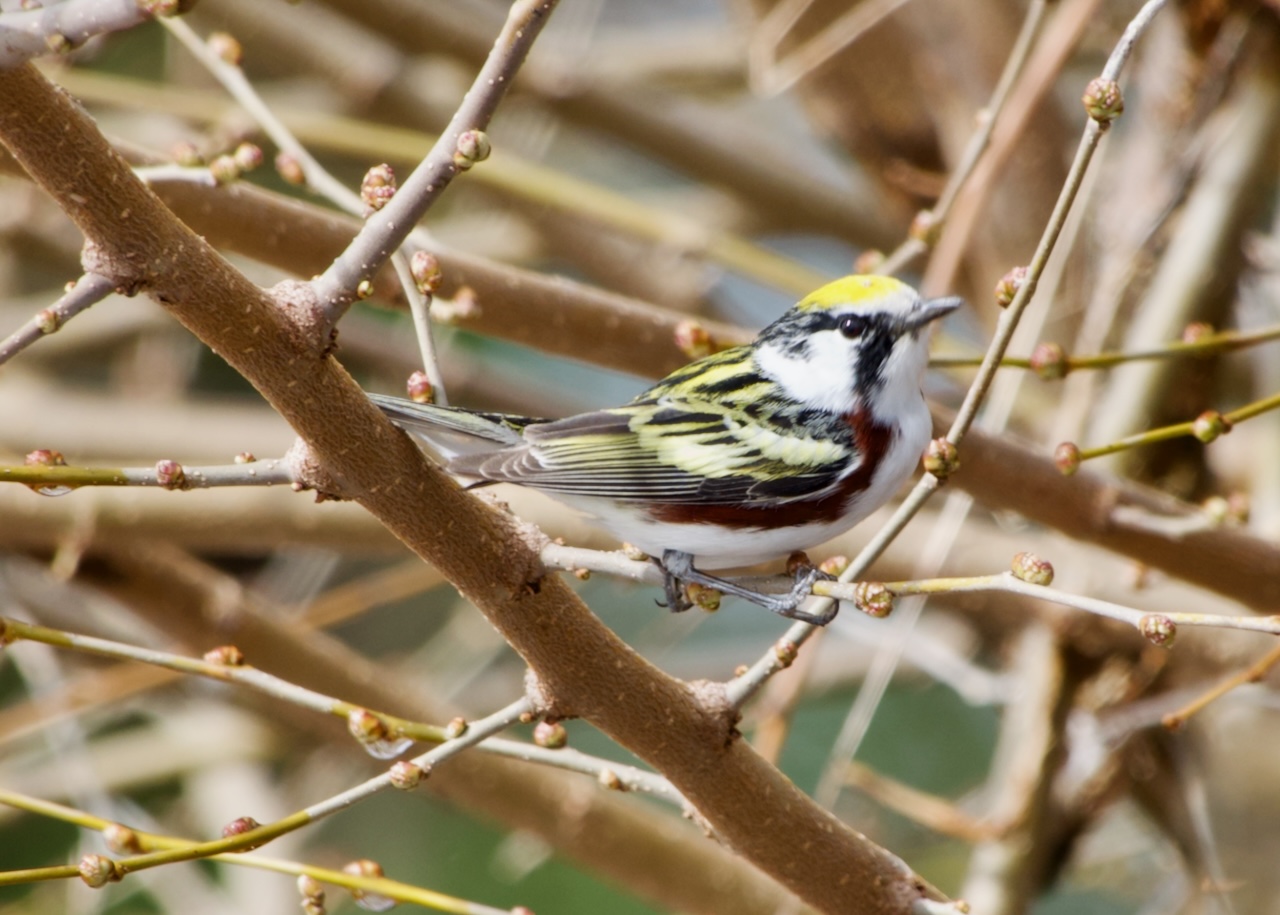
We finally left the Tip and chose the tram to save a few steps and headed up through the park to see if we could re-find a Yellow-breasted Chat that had been reported. It was hot again, with temperatures in the mid-twenties and the birding was decidedly uncomfortable. There were more birds around though and we were adding species regularly through the day. Blue-winged Warbler, Chestnut-sided Warbler, our first Hummingbird, Orchard Oriole to name a few. With no luck with the Chat we opted for a lunch in the park by our car and then we walked another trail where we finally got some nice pictures and video of a Northern Waterthrush. I got a report from Rondeau (1 hour away) of a Summer Tanager and we decided to go for it as the birding was slowing in the park.
I could see I had many Discord messages but the cell service can be horrible in the park at certain times so I got Jerry set with directions and finally could read my Discord messages. Markus (of Hamilton Big Year Birding Fame) had sent a note telling me I had a wrong ID on my list from the night before. I knew right away what it would be – the Tanager! Summer and Scarlet Tanager males are easy to tell apart but the females are more difficult and we had put in a female tanager as a Scarlet when in fact it was the Summer Tanager we were currently driving to find. I told Jerry to pull in and stop and he turned into Hillman Marsh, a birding spot that just happened to be where we were. I confirmed with Markus that it was the Tanager that was wrong and we both changed our checklists laughing about how ridiculous it would have been to drive an hour away for a bird we already had seen! Crazy! Since we were at Hillman’s we figured we would check it out although our stop yesterday had yielded no shorebirds and we had ended up not even putting in a checklist.

Paul and Liz from England quickly came over to tell us a Glossy Ibis was in the marsh! What?? You might remember that weeks back we drove from Pelee the 5 hours to Orillia to add a Glossy Ibis to our list and this week there is one right in Hillman, minutes from Pelee this week! Such is the birding life. We stayed and birded a bit and added another 3-4 species including a beautiful Wilson’s Phalarope.
While we were there other birders from Ottawa came over to let us know they had just come from getting the Snowy Egret – it was still in the same marsh. Jerry and I looked at each other and decided we would give it another try. We didn’t arrive until 5:30 and they were calling for thunderstorms in the next hour so the pressure was on. A photographer told us they had seen it just before but it had flown out of view. We went and checked the marsh carefully. And, no Egret. We walked, we scoped, we moved. We were viewing through reeds and shrubs and grasses and nothing. I was calming myself, willing the bird to please come out. Finally, one hour later Jerry saw some white birds fly in from where he was standing and we got the scope on them to see that one of them was very much smaller and had a black bill. It flew up a bit and the bright yellow feet were clearly visible. We had ourselves a Snowy Egret, another rarity! Jerry managed some distant record shots and the rain drops started. We drove down the road to a spot in Southwestern Ontario that you can get Yellow-headed Blackbirds to see if there were any around. The owner of the Trailer Park allowed us to go in and we found one by a feeder to end the day with 15 more species added.


On Tuesday before heading to the Tip we stopped at Cactus Field to try for the Chat. They are often more vocal in the morning and we were hoping to at least hear it. It was raining and then it was pouring and we were quickly drenched but it was short-lived. We made a couple of rounds on the path and then stopped at an area close to the first report that I had commented on being “good chat habitat” the day before and suddenly I heard the burbling and ch-ch-ch-ch of a Chat! I had Merlin running trying to record it and Jerry got his bins up and saw a bit of yellow in the tangle under a downed cedar tree! I got bins on it and it moved enough for both of us to see the yellow underparts, white spectacles and the olive back. It did not come out for a full view and Jerry could not get a picture before it disappeared on the other side of the log. But we had our Chat! Nothing much was happening at the Tip and the park seemed less birdy. South winds bring birds in but they also take birds out as they continue to head north to their breeding grounds and it seemed as if that might have happened. The only other bird we added to our list that day was the Prothonotary Warbler, a stunning bird with a golden yellow colour that really pops.

I made a mistake on Tuesday. A report came in while I was at the Tip that a rare Tricolored Heron was at Sky Lake – I tried a few times to get google maps to show me Sky Lake (shitty cell service again) and when it finally popped up I quickly clicked and it said 11.5 hours away so I instantly made the decision that it was too far. It wasn’t until mid afternoon having seen a few reports that it clicked that there are two Sky Lakes and the Heron was in Bruce-Grey County and not Algoma. UGGGGGH! Only 4.5 hours away. We could have gone for it. I was upset with myself for making a stupid quick mistake without taking the time to read the initial post properly. Later it was reported the bird had flown away around 2:30-3:00 so I rationalized that we probably would have missed it anyway. You cannot get them all.
Wednesday was even quieter in the Park and we started considering leaving early with north winds and cooler temperatures forecast for the next few days. We added a Veery and saw another Chat and then around 1:00 a report came in that the Tricolored Heron was back in the spot and had been seen by a number of people in the morning. I wish that someone had reported it to Discord first thing in the morning but not everyone thinks to do this so while some reports are instant many go unreported for hours or days. We made the decision to try for the Heron Thursday morning and head home a day early. It meant leaving Pelee for 5 days, which made me very nervous that I would miss something good but its all about playing the odds.
Thursday we drove up for the Tricolored Heron and waited around for about 3-4 hours hoping it would put in an appearance but it never did. Small consolation was 2 Brewer’s Blackbird that we would see in Rainy River but with it off the list gives us more time to spend on other species we will need to see.

We drove home disappointed but trying our best to foster our zen state of mind. We decided to try and get out to hear a Yellow Rail that had been reported in Guelph so headed up there after dinner. The Yellow Rail is a tiny, very secretive bird that you seldom see but can be heard. Its call sounds like stones/rocks being tapped together. We can generally get the Yellow Rail at Carden or Rainy River in June but nothing is guaranteed so, again, if we can get it off the list now, all the better. There were quite a few birders out, lined up along the area it had been heard and being very quiet. We all listened. It was a bit windy, the spring peepers were very loud, there was street traffic a short distance away and I was beginning to think that it had been a bad idea to try the night calling. After about an hour a few people at either end of our “line” heard the bird call with just a tic-tic. And then another birder thought he saw a small rail fly and that it might have been it. I could not honestly say I had heard it or seen it and Jerry had not either. We made the decision to leave as it was not likely even if it called again we would hear it clearly. A disappointing day with just 1 species added.
Friday morning we were heading into Hamilton to care give and bird a bit when a report of a Tufted Duck in Exeter came in from Max. We turned around and headed to Exeter. Rain started about an hour later and it was still lightly raining when we arrived. Jerry realized he had no rain boots in the car but a Tufted Duck was waiting. It was brutal conditions, with heavier rain and almost a fog as we tried to scan duck after duck. Not seeing it in the first lagoons we eventually made it around to the last back lagoon and I did a quick scan. We were looking for a duck with a tuft of hair (think mullet) off the back of its head and a blacker back then the other Scaup that are similar. We scoped and then I scoped again and suddenly there it was in the scope! I did a happy dance in the rain! Even though we were soaked we enjoyed watching him preen and toss his tuft around like humans toss their hair. He seemed very happy with his tuft LOL. Jerry got some pictures in very poor lighting and we headed back to the car sharing the sighting with a couple of other birders coming in. Jerry was sloshing in his shoes (he needs new ones) and we took off as much wet stuff as we could for the ride home. I love my heated seats in these circumstances! We headed home to change and get Jerry different shoes and then headed back into Hamilton to help out his Mom.

Our birding friend Cindy had gone back Friday morning and heard the Rail call around 7 so we opted to go back on Saturday morning to try for it without the spring peepers and other noise. It was much quieter at the marsh and a few birders from Hamilton came out to join us. Just after 7 the Rail called for about 30-40 seconds the tic-tic-tic-tic call.
We then birded a bit in Hamilton and Burlington in between visiting our daughters family and seeing Jerry’s mom again. We added 5 birds including an American Redstart in our yard when we got home. Unfortunately, we missed another Tricolored Heron in Collingwood and a Worm-eating Warbler at Pelee. Still migration is just starting so you never know, another Tricolored Heron was reported near Rondeau in the morning, Cattle Egrets and Little Blue Herons all have been seen but not staying in one place long enough to chase.
Sunday morning I woke early and looked up the Tricolored Heron in Collingwood and realized it had been there in 2023 and had stayed almost 2 weeks. I woke Jerry and we headed up there to try and see it. Jude from Hamilton was also on the way and let us know that it was there when we were still 15 minutes away. By the time we got there it had been flushed by a photographer getting a bit too close and was no where to be seen. Jude then refound it but it disappeared before we could get to where he was. We moved out into the Bay area for better site lines, walked around the area and waited. I was determined to see this bird. About an hour later the bird finally flew out of the reeds into full view. We have seen this species in Florida and the southern states and it is stunning.

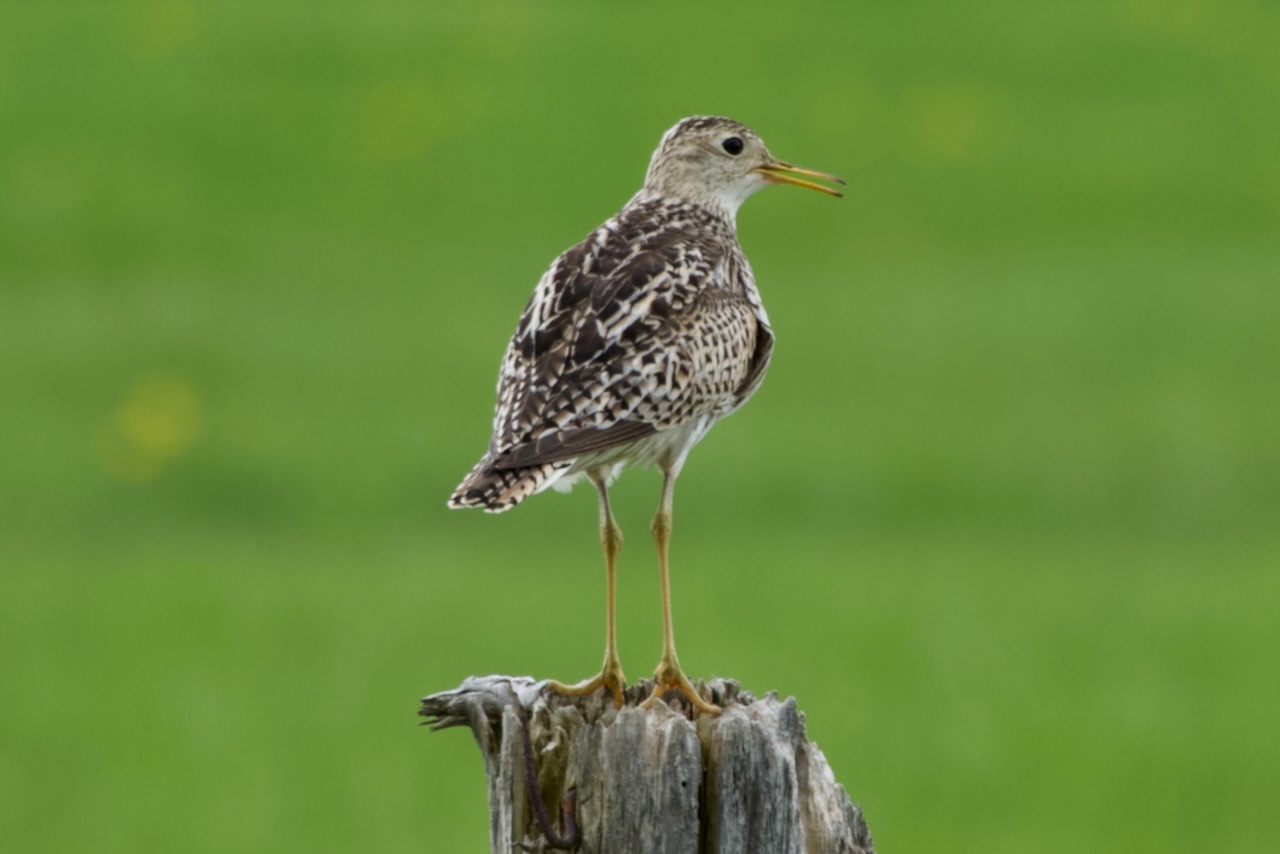
After some time feeding, the bird headed back into the reeds and then while we were still talking with some local birders Roy and Will, the bird flew out and returned to its original spot. We left and added a Least Flycatcher on the path on the way out and then headed to the airport where Roy had suggested we might find Upland Sandpiper and we did. A beauty on the fence.
Since we were 20 minutes from Wasaga Beach it made sense to stop and see the Piping Plovers that had already returned to the beach to breed. The Piping Plover is an endangered species in Ontario that returned to breed on our beaches in 2007 after a 30 year absence. Volunteers guard the plovers when they arrive and once nests and eggs are laid the nests are protected with wire cages and the area is cordoned off to avoid disrupting the birds and the young when they hatch. Wasaga Beach still has an active population but the numbers are still very small and the nests are not always successful. Our picture is just a record shot as the volunteers make sure that people stay a good distance away from the birds to give them every chance for success.

We headed home to pack for Pelee and spend some time with our other grandkids and son. After dinner we took a short drive around the corner to Grass Lake to see if the Bobolinks were back and we heard and then saw two performing their mating dances. Bobolink was our 260th bird! Only 40 away from our 300 goal. We have only 4 more common species to see and then continue to add migration birds. It was a wild first week of migration and much more to come.
Week 18 3 more rarities for a total of 23 rarities 44 species added this week to bring us to 260 species seen J&E